5 Ways “Just Playing Games” Made Me a Better Person
- 1. Patience and Effort: What Hard Games Teach
- 2. Empathy and Emotional Intelligence: The Power of Story-Driven Games
- Undertale: Don’t Fight. Listen. Understand.
- Hellblade: Senua’s Sacrifice: Understanding Mental Health
- Papers, Please: Empathy or Rules?
- Disco Elysium: Everyone Has a Reason
- 3. Leadership and Strategy: What Team Games and Simulations Can Teach
- Overcooked 2: Being a Team in the Middle of Chaos
- Football Manager: The Game of Quiet Leadership
- 4. Ethics and Moral Choices: The Power of Hard Decisions in Games
- Spec Ops: The Line: There Are No Real Heroes in War
- 5. Games Spark Historical and Cultural Curiosity
- Conclusions
Contents
- 1. Patience and Effort: What Hard Games Teach
- 2. Empathy and Emotional Intelligence: The Power of Story-Driven Games
- Undertale: Don’t Fight. Listen. Understand.
- Hellblade: Senua’s Sacrifice: Understanding Mental Health
- Papers, Please: Empathy or Rules?
- Disco Elysium: Everyone Has a Reason
- 3. Leadership and Strategy: What Team Games and Simulations Can Teach
- Overcooked 2: Being a Team in the Middle of Chaos
- Football Manager: The Game of Quiet Leadership
- 4. Ethics and Moral Choices: The Power of Hard Decisions in Games
- Spec Ops: The Line: There Are No Real Heroes in War
- 5. Games Spark Historical and Cultural Curiosity
- Conclusions
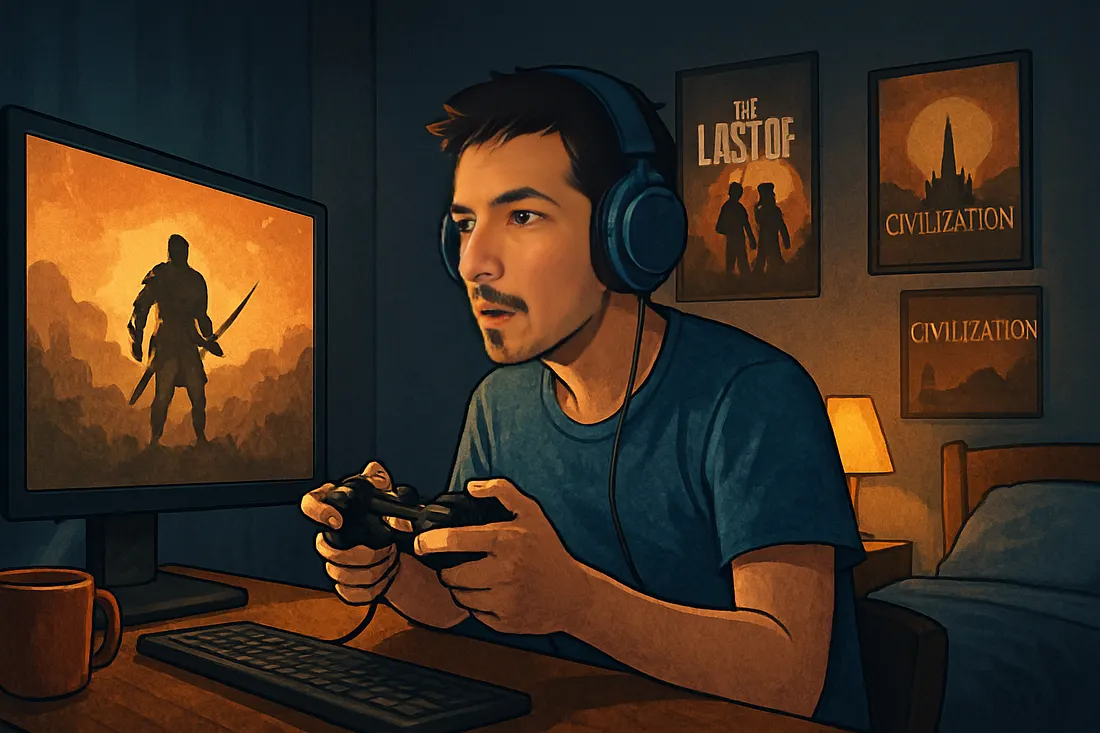
Image created by ChatGPT 4o
“You’re Playing Games? Must Have a Lot of Free Time!”
People often say that video games are a waste of time. But new studies and player stories show the opposite. The right games can help players grow mentally, emotionally, and even in their skills. Even the games we buy just for fun can help us learn about talking with others, making decisions, and thinking ahead, the core skills of leadership, as this article shows. In this post, I’ll show how different types of games can help you improve yourself, with examples of games and what they teach.
1. Patience and Effort: What Hard Games Teach
Hard games are known for teaching patience and not giving up. Especially “Souls-like” games (like Dark Souls, Sekiro: Shadows Die Twice) need time and effort. In these games, you die a lot, but each time you try again, you learn something. These games reward your patience: you make progress as you learn the enemies’ movement patterns and come up with strategies. You don’t get stronger; you become better.
Many players say even dying in these games is a way to learn. After each loss, you say, “Maybe this time I can do it,” and try again. This teaches us to keep going in life, even when it’s hard. Beating a tough boss after patiently trying again and again gives you a huge sense of confidence and achievement. In short, games that demand patience and persistence train players in determination, coping with stress and learning from mistakes.
I haven’t played a Souls-like game myself. But there are other games that teach patience. Some games teach you to win not by fighting, but by waiting.
Like This War of Mine… In this game, you control normal people trying to survive in a war. Every decision you make has big results. You think, “If I go now, will I get shot?” or “If I steal from this man, will I feel bad tomorrow?” But if you wait and survive a hungry night, maybe help will come tomorrow. This game shows what patience really means. Warning: very emotional.
Another one is The Long Dark. You’re alone in nature. You fight cold, hunger, wild animals, and the dark. When you find a warm stove or a little food, you feel really happy. In this game, patience is not just nice to have — it’s how you stay alive.
Even Stardew Valley can teach patience. You plant today, and eat the fruit months later. This game tells you to think long-term. You work every day and wait to see the result. You can’t do everything in spring. Some things need summer, some need fall. And this waiting teaches us what “the right time” means in real life, too.
2. Empathy and Emotional Intelligence: The Power of Story-Driven Games
Games with strong stories and deep characters help you feel what others feel. In these games, you live the story of someone else. For example, games like Life is Strange or The Last of Us, or smaller emotional games like That Dragon, Cancer or To the Moon, help you understand what others go through and feel the emotional weight of their decisions.
People who often play role-playing games (RPGs) get used to being in someone else’s shoes, and it has been said that this practice gives them stronger empathy skills. They see how their choices affect others, and this helps them grow emotionally.
Sometimes, games help us care about things we never thought of before. Like in Detroit: Become Human, you see the world through the eyes of android robots who are treated like machines. The game makes you ask, “What would I do if I were them?” or “What should I do for them?” It pushes our empathy even further. This way, players learn to empathize not only with human characters but also with beings that are not human yet can still feel.
These games help us understand others, break our biases, and grow our feelings. Even in multiplayer games, when you work as a team and help others, it makes your empathy skills stronger. And it’s not just sad stories that teach empathy. Some games show that there’s no clear “good” or “bad” side, and those are powerful too.
Undertale: Don’t Fight. Listen. Understand.
This game looks like a normal RPG, but it’s really about your heart. You can talk to enemies instead of fighting them, find out why they are hostile, and get through the levels peacefully. And if you do, you feel something real. If you fight, you face the results. This makes you think: “Did I have another choice?” — and that’s where empathy starts.
Hellblade: Senua’s Sacrifice: Understanding Mental Health
This game tells the story of a girl with psychosis. You hear voices, feel fear, and see her struggle between real and unreal. With headphones, it feels very real. The game shows what mental illness can feel like — and helps us understand it better. The atmosphere is so well done that it makes you empathize even in situations where we would normally say, “I can’t understand what you’re feeling.”
Papers, Please: Empathy or Rules?
You’re a passport officer at a border. You check the papers and try to stop illegal crossings. But every person has a story: a sick woman, a refugee, a father… If you break the rules, you lose money. If you don’t, you feel bad. Each paper check becomes a moral choice. “Rules or people?” you ask yourself every day.
Disco Elysium: Everyone Has a Reason
You play as a broken man who doesn’t even know himself. But because you’re broken, you understand others better. Whether you’re talking to a drifter who had a rough childhood or to intellectuals rebelling against the system… Everyone in the game has been hurt in some way. This game makes you listen instead of judge. In this world, empathy isn’t extra — it’s how you survive.
3. Leadership and Strategy: What Team Games and Simulations Can Teach
Some games help players get better at leadership, teamwork, and thinking ahead. In online team games (like MOBAs, MMORPGs, or team-based shooters), players must work together, share roles, and sometimes take the lead. One player often becomes the leader and tries to motivate others, solve problems, or make group decisions.
Research by Nick Yee from Palo Alto Research Center shows that young people who play online group games feel they’re better at leading, motivating, and solving conflicts. For example, leading a raid in World of Warcraft or making a team plan in League of Legends helps you practice leadership and communication skills.
Also, strategy and management games improve planning and thinking ahead. Real-time strategy (RTS) games or city/business simulators (like Civilization, StarCraft, SimCity, Football Manager) ask you to use your resources well, plan many steps ahead, and manage complex systems. These games help players get better at making choices, building strategies, and thinking about results.
In one study, students who did well in Civilization also got higher scores in tests about planning and problem-solving. The researchers said that to win in such games, you need to plan every step, think deeply, and even work with others. So games can copy real-life leadership and help us improve. Whether it’s a team-based online game or a solo strategy game, video games give us a chance to practice leading, working together, making quick choices, and long-term planning.
Overcooked 2: Being a Team in the Middle of Chaos
It looks cute, but it’s really a lesson in leadership. Everyone moves at the same time, and if one person is late by a second, everything goes wrong. Who will move fast? Who will say “I’ll help”?
Overcooked teaches us the value of “you take the right side, I’ll do the dishes.” It shows why talking calmly and sharing roles are important. Leadership here means listening, fixing problems quickly, and talking clearly.
Football Manager: The Game of Quiet Leadership
You don’t press keys — you just manage. You control transfer money, player feelings, training plans… everything. You must bring success from the sidelines. The hard part? If things go wrong, it’s your fault. But when things go well, you still get little credit. It feels just like real-life leadership.
4. Ethics and Moral Choices: The Power of Hard Decisions in Games
Many new games make players face ethical and moral questions, and this sharpens their sense of values and their decision-making skills. In RPGs and interactive stories, you often make big decisions that change the story. There’s no clear right or wrong. You must think about the results.
Disco Elysium is one of the deepest RPGs in recent years. In almost every moment, you choose your path. The decisions you make shape your detective character. And as your character changes, the game offers different options.
This means you can play in a way that fits your own values or take a totally different path. Many players ask, “What would I do in real life?” The game makes you face yourself. It even covers politics, personal beliefs, and more, like a mirror showing your morals.
Detroit: Become Human is another game full of ethical choices. It tells the story of androids gaining feelings and fighting for freedom. You must often choose between two hard options, and you see the results right away. This makes you feel the weight of every choice. Most of the time you have to decide fast, which often leaves you torn between your conscience and your logic. An experience like this can build ethical decision-making skills and the habit of thinking about consequences ahead of time.
The game also lets you play as the ones people usually see as “bad”, the androids. And it shows how unfairly they’re treated. This is one of the strongest messages in any game: Can we feel for robots? The answer helps us understand how we treat others who are different. This game makes us question our hidden biases, even when we don’t realize we have them.
Of course, Disco Elysium and Detroit aren’t the only ones. Many games have morality systems. In games like Fallout or Fable, your good or bad actions change your “karma.” In my favorite game, Mass Effect, your choices are labeled Paragon (good) or Renegade (tough), and they affect who lives, who dies, and how the story ends. In The Witcher or The Walking Dead, your choices decide if someone survives or the whole story changes. These games give players a chance to test their own ethical values inside the game.
We call them games, but in the end, we sometimes ask: Was I a good person or not? These games become a space to think about who we are and what we believe.
And maybe the most powerful one:
Spec Ops: The Line: There Are No Real Heroes in War
At first, it looks like just another war game like Call of Duty. But soon, the game isn’t about aiming, but your conscience. One of the strongest moments: You use a white phosphorus bomb, following orders. But after that…
You see burned civilians on your screen. You thought you were a good soldier. Now you face what you did. The game doesn’t hit your character — it hits you.
And the worst part? You learn that the people you killed were actually soldiers trying to help. There are no clear good or bad sides here. Only choices and their weight.
Spec Ops: The Line isn’t a fun game. It’s a hard one. Not because it’s difficult, but because it shakes you. It doesn’t hit you when it ends. It hits you when you stop and think about what you did.
I know I gave a spoiler, but please play it. That shock can be as deep as reading a strong book.
5. Games Spark Historical and Cultural Curiosity
Some video games don’t just entertain — they also make you curious about history, mythology, and different cultures. For example, games like Assassin’s Creed or Age of Mythology introduce you to Greek, Egyptian, and Norse myths. From the names of gods to unit types, many details come from real history. The Assassin’s Creed series, for its part, puts historical periods, places, and cultural atmosphere at the center of the game experience.
After playing, you might think, “There were treasures here? Who was Ra? What was Odin’s power?” and find yourself searching through books or watching documentaries.
Age of Empires II is similar — it takes you straight to the Middle Ages. You control famous names like Genghis Khan, Joan of Arc, or Ottoman leaders. While learning about battle tech and farming systems, you’re also learning real history. Each campaign is based on real events, and before each mission, a narrator explains the political background. You’re basically taking a history lesson without even knowing it.
Civilization VI is like a lab for human history. You can go to nuclear war with Gandhi or start a science revolution with Cleopatra. Every leader comes with real historical background, and you must build your strategy around it. The game also includes a Civilopedia, an in-game encyclopedia, where you can read about the history of each unit or building.
These games are not just about learning, but also let you create. You can make your own maps, missions, and stories. So you become not just a player, but a kind of game designer. While doing that, you develop technical skills (like map editors, scripting) and storytelling skills.
Games like Skyrim, Mount & Blade, or Minecraft have hundreds of cultural mods made by the community. These show that players are also creators, not just consumers.
And sometimes, while playing Skyrim, you forget the magic and just wonder, “Was life in the Middle Ages really like this?” You visit a blacksmith and suddenly think, Could I have been a blacksmith’s apprentice like Pip in Charles Dickens’ Great Expectations? You start to feel and live in the past.
So a game can take you not just to battlefields, but to libraries, museums, forums, and creative tools. That proves that games can be more than fun. They can also be a door to historical and cultural discovery.
Conclusions
As you can see, when played the right way, video games can really help with personal growth. Hard action games teach you patience and how not to give up. Story-rich games help you understand others and grow your emotional intelligence. Team games improve leadership, communication, and teamwork. Strategy games build your planning and problem-solving skills.
And what’s great is that you don’t need “educational games” to learn these things. Even games we play just for fun can give us these skills without us even noticing.
Today, many experts say that video games, when used wisely, can be more than just free-time fun. They can be real skill-building tools for both young and older people. In fact, some researchers say that being good at certain video games may even help in your career or education.
What matters is choosing good games, keeping a healthy balance in your life, and trying to use what you learn from games in real life, too.
In short, video games — when played with the right mindset — are not just entertaining. They can also be educational and transformational. And that might be the best proof that video games are not a waste of time.
Sources: Besides my personal comments, the information in this post was put together using various articles, blog posts, and player reviews:




Frequently Asked Questions
▸What real-life skills can video games teach you?
Video games can teach patience, empathy, leadership, decision-making, and strategic thinking. Different genres build different skills — hard games build resilience, story games grow emotional intelligence, and team games develop communication and leadership.
▸Which games are best for building patience?
Souls-like games like Dark Souls and Sekiro teach patience through repeated failure and learning. Survival games like The Long Dark and slow-paced games like Stardew Valley also reward long-term thinking and waiting for the right moment.
▸How do video games improve empathy?
Story-driven games put you in someone else's shoes and show how your choices affect others. Games like Undertale, Detroit: Become Human, Hellblade, and Disco Elysium help players understand different perspectives, mental health struggles, and moral complexity.
▸Can video games make you a better leader?
Yes. Research by Nick Yee from Palo Alto Research Center found that players of online group games report stronger leadership, motivation, and conflict-resolution skills. Leading a raid in World of Warcraft or coordinating a team in League of Legends directly practices real leadership.
▸Do strategy games improve problem-solving skills?
Studies show students who performed well in Civilization scored higher on planning and problem-solving tests. Games like StarCraft, SimCity, and Football Manager require managing resources, thinking multiple steps ahead, and making complex decisions under pressure.
▸What does This War of Mine teach players?
This War of Mine puts you in control of civilians surviving a war zone. Every decision carries serious consequences, teaching patience, moral weight, and the cost of choices. The game is noted as highly emotional and a strong teacher of real-world empathy.
▸How does Undertale teach empathy differently from other RPGs?
Unlike most RPGs, Undertale lets you talk to enemies instead of fighting them. If you choose violence, you face the consequences. This design forces players to ask whether they had another choice, making empathy a core mechanic rather than a side effect.
▸Can video games help people understand mental health?
Hellblade: Senua's Sacrifice is specifically designed to simulate psychosis. Players hear voices and experience distorted reality, giving them a first-hand feel for what mental illness can be like. The game is widely recognized for building genuine understanding of mental health.
▸Are video games actually a waste of time?
The post argues they are not, citing player experiences and research. The right games build mental, emotional, and practical skills. Even games bought just for fun can teach communication, decision-making, and forward thinking.
▸What does Papers, Please teach about moral decision-making?
In Papers, Please, you play a border officer where every person crossing has a human story. Breaking rules costs you money; following them may harm innocent people. This creates daily moral dilemmas that mirror real-life ethical conflicts between rules and compassion.