
How I Earned My PSM I Certificate #3: The Exam, Using AI and Tactics
The image was put together in Canva with the logo, font and badge provided by scrum.org.
I'm here with a few golden tips from my own experience preparing for the PSM I exam and the tactics I used. In this post I'll share what the exam is really like and the ways to prepare that work best. Let's get started!
Hello from the third post in my series about Scrum. You can find the other posts in the series below:
The PSM I Exam at a Glance
Time: You have 60 minutes, so you need to use your time well. That's about 45 seconds for each of the 80 questions. Time management is a big part of the exam. On complex scenario questions especially, you have to read fast and understand correctly to save time.
Passing score: The 85% passing score shows how hard the exam is. Let me save you the calculator: you need 68 correct answers out of 80. This high bar really tests your Scrum theory and your ability to put it into practice, and it makes the certificate worth more.
Difficulty: Some questions come straight from the Scrum Guide, while others call for interpretation and analysis. Some of these questions test not only whether you understand the text but also how well you can judge a situation. We'll see this in more detail in the sample questions below.
Language and meaning:
The questions are in English, but they are written in clear and simple language, so basic English is usually enough if you know the technical terms. If you are not familiar with the Scrum terms in English, it can help to study the English Scrum Guide side by side with a version in your own language, as our team did with the Turkish one. Make sure you read the English version many times.
Using AI on the PSM I Exam
Using AI during the exam is something people often ask about. These so-called AIs(!), the ones that will supposedly leave us all jobless or even take over the world, are really just the simple language models we can use today. Their progress in recent years makes people think they could give you an edge in exams. But it's not quite that simple. Well, the people who write the exams aren't fools either. Here is why using language models on the PSM I is a bad idea:
Not enough time: You only have 45 seconds per question. That is nowhere near enough to understand the question, paste it into a language model, get an answer and check that it's right. On complex scenario questions, managing your time gets even harder.
The limits of language models: Language models usually give shallow, general answers. On an exam like PSM I, which needs deep knowledge, their answers may not be accurate or reliable enough. For example, a model may answer a simple question like “What is the purpose of the Daily Scrum?” correctly but fail a harder one like “What are the limits of the Scrum Master's authority in the team?” They have even gotten a question about Scrum Team size wrong.
Outdated knowledge: Language models only know the data they were trained on, up to a certain date. Even a small change in the current Scrum Guide can change the answer, so they risk answering with old information.
Misleading answers: When language models don't understand a question, they sometimes make up an answer. These answers may look trustworthy but can be wrong. In a tricky exam like PSM I, even one small mistake can hurt your chances of passing. Take this question, which also appears in the practice tests:
“What is the typical size of a Scrum Team? (Choose the best answer.)
Options:
A. 9.
B. 10 or fewer.
C. 7 plus or minus 3.
D. At least 7.”
The correct answer is B, “10 or fewer”, yet ChatGPT's GPT-4o model still shamelessly picks C:
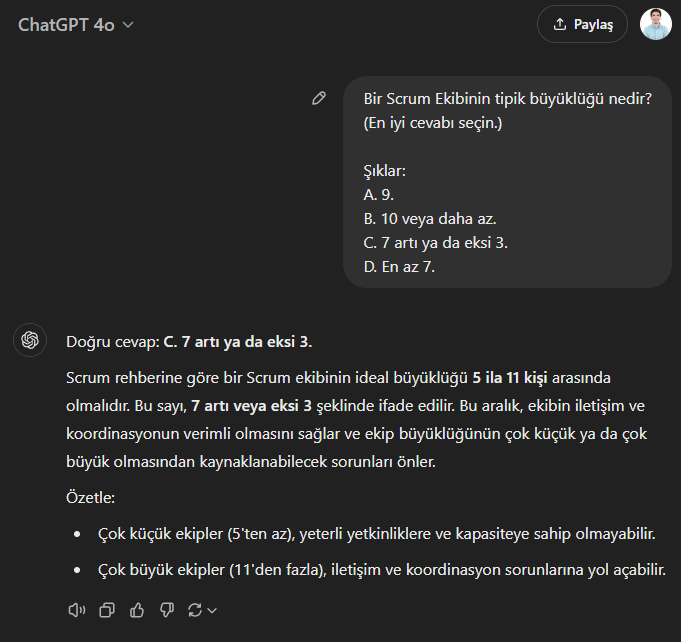
Screenshot by the author.
Repetitive answers: These cute little language models are very limited at judging the answer they are about to give. They are known for giving the same wrong answer to the same question again and again.
Unusual wording: Since they can't really reason and are very limited at judging their own answers, they may see certain words, assume that must be the right answer and fall into the exam's traps. I probably don't need to tell you that big exams like this are full of traps.
Sometimes language models give answers so confident, yet so wrong, that you'd think they wrote Scrum themselves!
Why Studying Works Better
In the end, the best way to pass the PSM I is to study, understand the material well and practice. Here are a few reasons to choose studying over language models:
Real knowledge: Language models can give you information, but it isn't always correct. When you take the exam with what you've learned yourself, you can judge every answer on your own.
Speed and understanding: Understanding the questions quickly and correctly is the most critical part of the exam. The only way to build that skill is lots of practice.
Thorough preparation: The PSM I tests not only theory but also your ability to interpret and solve problems. Building these skills by studying gives you a big advantage in the exam.
Knowledge for real life: The concepts and principles you learn for the exam matter not just for getting a certificate but for using them well at work. That's why it's important to understand them deeply and know how to apply them.
The Tricky Parts
Similar terms:
Some terms in the Scrum Guide are so similar that they can confuse you. For example, you need to be clear about what Increment and Definition of Done each mean.Staying true to the Scrum Guide:
The questions are based only on the definitions and principles in the Scrum Guide. Scrum as practiced in companies can look different and drift away from the guide. To answer correctly, stick to the theory.Complex scenario questions:
Understanding long scenarios and reaching the right answer takes focus. The exam tests your theory and your practical problem solving at the same time.Convincing wrong options:
The options often include statements that look very close to the right answer but are completely wrong. Watch out for these distractors.Events and artifacts together:
You need to understand how Scrum's events and artifacts connect. For example, knowing which artifacts are reviewed during the Sprint Retrospective can be tricky.Questions about stakeholders:
Questions about how and how much stakeholders should be involved need care. You should understand their role well, especially in events like the Sprint Review.Where Scrum applies:
Questions about whether Scrum can be used only in software development or in other industries too can be confusing.
Still, the reasoning skills we built the hard way in Türkiye's university entrance exam, which changed its name before we could even memorize it, give us quite an edge over people who have never faced exams like that.
These tricky parts can challenge any candidate, but with the right preparation and strategy you can get past them easily. Remember, these challenges will make you a stronger Scrum Master. Now let's look at a few questions I found hard, along with their answers.
The Questions I Found Hardest
I was dead sure I'd write this post, so I made a note of the hard questions. Let's go through them and think about why they felt hard:
The IT manager asks the Scrum Team for a status report describing progress throughout the Sprint. The Scrum Team asks the Scrum Master for advice. What should the Scrum Master do?
A. Talk to the IT manager and explain that progress in Scrum is assessed by inspecting the Increment at the Sprint Review.
B. Tell the Scrum Team to find a solution themselves.
C. Create the report and hand it to the manager yourself.
D. Tell the Developers to add the report to the Sprint Backlog.
E. Ask the Product Owner to send the report to the managers.The Daily Scrum is an event that happens every day. If it were held only every two or three days, what would be three key concerns?
(Choose the best three answers.)A. Too much time is spent updating the Scrum board.
B. The Product Owner cannot report progress to the stakeholders accurately.
C. Opportunities to inspect and adapt the Sprint Backlog are lost.
D. The Sprint Backlog may become inaccurate.
E. Impediments are raised and resolved more slowly.
F. The Scrum Master loses the ability to update the Gantt chart properly.You are the Scrum Master for four Scrum Teams working from the same Product Backlog. Some of the Developers complain that, over the next two Sprints, there is work that needs a full-time commitment from an expert outside the teams. As the Scrum Master, what should you consider when deciding what to do about this complaint?
(Choose the best two answers.)A. The benefits of letting the Developers find their own solution.
B. The wish to keep a stable velocity.
C. The Scrum Teams' ability to produce integrated Increments.
D. The need for enough work to keep all Developers busy.User documentation is part of your Definition of Done. However, there aren't enough technical writers for all the teams. Your Scrum Team has no technical writer. What should the Scrum Team do?
A. The Developers on the Scrum Team should write the user documentation.
B. Wait until a technical writer is added to the Scrum Team and have that person do it.
C. Set up a separate team of technical writers who work on request, first in, first out (FIFO).
D. Leave the user documentation undone and wait for any available technical writer to finish it after the last development Sprint.The Developers ask the Product Owner to reorder the Product Backlog. The team is waiting for an external supplier to deliver a component. Without that component, there won't be enough work in the next Sprint to keep the whole team busy. As the Scrum Master, what would you advise the Product Owner?
A. Tell the Product Owner to reorder the Product Backlog so the work on the external component can be planned in a separate Sprint.
B. Tell the Product Owner that the Product Backlog should be ordered to make the most of the Developers.
C. Remind the Product Owner that their main concern should be ordering the Product Backlog to reflect the flow of value.What increases the transparency of an Increment?
A: Keeping Sprint tasks accurately updated in an electronic tracking tool.
B: Tracking and estimating all unfinished work to be completed in a “hardening” Sprint.
C: Reporting Sprint progress to stakeholders every day.
D: Doing all work in line with the Definition of Done.
Answers
Correct answer: A.
In Scrum, progress is assessed at the Sprint Review. Daily status reports go against the spirit of Scrum.
Correct answers: C, D, E.
C: Without a Daily Scrum, the chance to inspect and adapt the Sprint Backlog is lost.
D: The backlog no longer reflects the real situation.
E: Impediments are not spotted in time.Correct answers: A, C.
A: The Developers should find the solution; this makes the team more independent.
C: All teams need to produce integrated Increments.Correct answer: A.
Having the Developers finish the documentation, instead of waiting for a technical writer, keeps the work moving.
Correct answer: C.
Ordering the backlog is about putting the flow of value first, not about keeping teams busy.
Correct answer: D.
An Increment is transparent when it meets the Definition of Done.
My Tips for the Exam
Master the language of the Scrum Guide:
The wording in the Scrum Guide is very specific, and the exam questions match its terms and definitions exactly. That's why understanding the guide's language and knowing its concepts well is so important.Memorize the key concepts:
Learning the definitions of core concepts like artifacts, events and roles, and how they relate to each other, makes the questions easier to solve. You can find the first post, where I explain these concepts in detail, at the link below:
How I Earned My PSM I Certificate #1: What Is Scrum?Always take the practice tests:
Once you score 100% several times in a row on the practice tests from Scrum.org, which you can find here, you're ready for the exam.Make your own notes:
Write down what you learn in the training, the points you find important in the guide and, if you've read them, short summaries from your trainer's books. These notes are great for a quick review before the exam.Don't use your real-life experience if it's wrong:
If you've worked with Scrum, of course you can use that experience to interpret the questions. But during the exam, forget the practices that Scrum doesn't like.Compare the Scrum Guide in English and in your own language:
Knowing what the English terms mean in your own language helps you understand the questions better.Last-minute study:
The day before the exam, study only from your short notes and the practice tests. Focus on keeping your mind fresh.Plan your time:
Remember that you have about 45 seconds for each question. Don't get stuck on any one of them, and come back at the end if you have time left.Avoid distractions:
Take the exam in a quiet, comfortable place.Don't stress:
With the right preparation, you can definitely pass. Staying calm and sipping water now and then will help you perform better.
Conclusion
The PSM I isn't just a knowledge test. It also takes strategy, focus and preparation. If you learn the Scrum Guide, do the practice tests and stay disciplined, you can get through it with confidence. Remember, becoming a Scrum Master is less about earning a certificate and more about taking on a new way of thinking. With the right tools, persistence and a calm head under pressure, you can definitely succeed. Good luck on your Scrum journey! 🚀
Frequently Asked Questions
▸How long is the PSM I exam?
You get 60 minutes for 80 questions, which is about 45 seconds per question. Time management is a big part of the exam.
▸What score do you need to pass the PSM I?
The passing score is 85%, which means at least 68 correct answers out of 80.
▸Can you use AI during the PSM I exam?
It doesn't help. With about 45 seconds per question, there is no time to ask a language model and check its answer, and models often give confident but wrong answers, even on simple questions like the typical size of a Scrum Team.
▸Why are language models unreliable on PSM I questions?
They give shallow, general answers, may rely on an outdated Scrum Guide, can make up answers when they don't understand a question and tend to fall for trap words. On an exam with an 85% passing score, even one such mistake hurts.
▸What are the hardest parts of the PSM I exam?
Telling similar terms apart, such as Increment and Definition of Done, sticking strictly to the Scrum Guide instead of habits from your company, long scenario questions and wrong options that look almost right.
▸How should you prepare for the PSM I?
Learn the Scrum Guide's exact wording, memorize the key concepts, take the Scrum.org practice tests until you score 100% several times in a row, keep your own notes and plan for about 45 seconds per question.