My Sci-Fi Maddness #3 “The End of Eternity” and “1984”: A Comparison on Time and Mind
- This post contains spoilers for Isaac Asimov’s The End of Eternity and George Orwell’s 1984.
- Short Summary of the Book
- Main Characters
- Themes
- Upper-Timers or Lower-Timers?
- 🔬 Sci-Fi Elements in the Book
- 1. Physiotime
- 2. The Institution of Eternity
- 3. Time Kettles
- 4. Human Computers
- 5. Micro-Change Theory
- 7. The Moment You Meet Yourself (Closest Thing to a Time Paradox)
- Things That Bothered Me
- If You Can Keep Up with the Time Jumps, I Owe You a Coffee
- Expecting Me to Emotionally Invest in Noÿs Was a Bold Move
- Living by Stats: Dystopia or Marketing Presentation?
- Common Grounds: Control, Reality, and Love
- 1. Control Mechanism
- 2. Love and Awakening Against the System
- 3. Manipulation of the Past
- 4. Alienation of the Individual
- 5. Language and Knowledge as Tools
- 6. Cold Institutions and Bureaucracy
- 7. Isolation and Fading Communication
- Where They Split: Dystopia vs. Hope, Destruction vs. New Beginnings
- Tone and Purpose:
- View on Technology:
- Individual Action
- Awareness and Change
- Mood
- Conclusion: Mind Control vs. Time Control
Contents
- This post contains spoilers for Isaac Asimov’s The End of Eternity and George Orwell’s 1984.
- Short Summary of the Book
- Main Characters
- Themes
- Upper-Timers or Lower-Timers?
- 🔬 Sci-Fi Elements in the Book
- 1. Physiotime
- 2. The Institution of Eternity
- 3. Time Kettles
- 4. Human Computers
- 5. Micro-Change Theory
- 7. The Moment You Meet Yourself (Closest Thing to a Time Paradox)
- Things That Bothered Me
- If You Can Keep Up with the Time Jumps, I Owe You a Coffee
- Expecting Me to Emotionally Invest in Noÿs Was a Bold Move
- Living by Stats: Dystopia or Marketing Presentation?
- Common Grounds: Control, Reality, and Love
- 1. Control Mechanism
- 2. Love and Awakening Against the System
- 3. Manipulation of the Past
- 4. Alienation of the Individual
- 5. Language and Knowledge as Tools
- 6. Cold Institutions and Bureaucracy
- 7. Isolation and Fading Communication
- Where They Split: Dystopia vs. Hope, Destruction vs. New Beginnings
- Tone and Purpose:
- View on Technology:
- Individual Action
- Awareness and Change
- Mood
- Conclusion: Mind Control vs. Time Control
Photo is prepared by Author with ChatGPT and Canva.
Welcome 😊
If this is your first time seeing this series, click here to read the introduction.
This post contains spoilers for Isaac Asimov’s The End of Eternity and George Orwell’s 1984.
I had been eyeing the book club regularly meeting for quite some time. They seemed warm and thoughtful, and I knew they weren’t strict — just reading one book a month, no pressure. When I heard that they would read Isaac Asimov’s The End of Eternity in March 2025, something clicked in me. I’ve always loved Asimov. I’ve always loved sci-fi. But still, I had hesitated to join.
Then, out of nowhere, my love for sci-fi came rushing back. I thought, “It’s been so long since I read any science fiction. Let me join — it’ll be something fun, I’ll meet some cool people, and I get to read sci-fi again.” So I borrowed the book from the IBB (Istanbul Metropolitan Municipality) Atatürk Library — thanks to my wife Nare’s library card.
It was right around the time when Ekrem İmamoğlu, the mayor of Istanbul, was arrested based on vague accusations and anonymous witnesses. Life felt like a dystopia. I couldn’t get 1984 out of my mind — I had already been feeling like we were living inside that book. And that line from Animal Farm haunted me too: “All animals are equal, but some animals are more equal than others.”
Since Nare works at the IBB, we were personally affected. We didn’t know what would happen, and there was a quiet sadness in our home. That’s the mindset I was in when I started reading The End of Eternity.
As I kept reading The End of Eternity, I started spotting more and more similarities with 1984, especially considering everything going on around me. I thought, “There’s no way all of this is just a coincidence — I have to talk about these in my book club.” So I took notes. When I shared my thoughts during our meeting, some people agreed with me, some agreed on certain points, and some didn’t. But what made me happy was this — I was having a real conversation with smart people who had read both books.
Before jumping into the comparisons, let me first talk a bit about The End of Eternity. Like I do with the other books in this series, I’ll take a good deep dive — let’s see what I roast and what I praise.
Short Summary of the Book
Published in 1955, The End of Eternity by Isaac Asimov stands out as one of his most philosophical and romantic works. While Asimov usually focuses on how scientific systems work and how people interact with them, this book takes a very different path. Built around ideas like time travel, ethical interference, love, and free will, it doesn’t directly connect to the Foundation or Robot series — but it helps lay the groundwork for them.
In Asimov’s universe, the events in The End of Eternity are actually a precondition for the creation of the Foundation universe. Once Eternity comes to an end, time flows freely again, and humanity can finally spread across the galaxy — a key idea behind the Foundation series.
The main character, Andrew Harlan, works as a Technician at a time-transcending institution called “Eternity.” This organization tries to build an “ideal” future by making small changes throughout human history. But everything changes when Harlan falls in love with Noÿs Lambent during one of his missions. That love leads him to question the whole system — not just for personal reasons, but in a way that sparks a revolution that could reshape all of humanity.
Harlan describes his work to Noÿs like this:
There’s no fun in Eternity, lady. We work! We work to plot out all the details of everywhen from the beginning of Eternity to where Earth is empty, and we try to plot out all the infinite possibilities of all the might-have-beens and pick out a might-have-been that is better than what is and decide where in Time we can make a tiny little change to twist the ia to the might-be and we have a new is and look for a new might-be, forever, and forever, and that is how it has been since Vikkor MaUansohn discovered the Temporal Field in the 24th, way back in the Primitive 24th, and then it was possible to start Eternity in the 27th, the mysterious Mallansohn whom no man knows and who started Eternity, really, and the new might-be, forever and forever and forever and… (Page: 55)
Main Characters
Andrew Harlan: A time technician. He works in Eternity and believes in the system — until love makes him question everything.
Noÿs Lambent: A mysterious woman from the Lower Time. Harlan falls in love with her. But she’s much more than she seems.
Laban Twissell: The oldest Computer in Eternity. He deeply believes in keeping the system alive and is the mind behind many strategic moves.
Brinsley Sheridan Cooper: A character who shapes Harlan’s career path and plays a key role in the future.
Finge: Harlan’s first boss. Strict, pragmatic, and by-the-book.
Themes
Free will vs. fate: How changes made “for humanity” erase individual choices.
Time and ethics: The moral boundaries of time travel.
Love and transformation: How one emotion can shake an entire system.
Control and evolution: Sacrificing human potential for the sake of a “safe” future.
The story moves in a linear way, slowly revealing how Eternity works and the moral dilemmas behind it through Harlan’s journey. This setup helps the reader deeply understand both the characters and how the events unfold.
One of the most striking parts of the novel is its conflicted view on technology. Even something as advanced as time travel isn’t just used “for good” — it’s also used to push people into one narrow path. Eternity doesn’t care about personal freedom; it’s more focused on a happiness index calculated by machines. So the novel becomes much more than just a sci-fi tale — it turns into a deep reflection on ethics, love, will, and change.
Asimov also questions something that’s both scientific and philosophical: the idea that changes made by Eternity don’t last. Time itself seems to have a kind of “inertia” — any change fades over a few centuries, and reality tends to return to its old form. This shows how temporary and shallow Eternity’s efforts really are. The system always resets into balance, but it’s a balance that’s static, not forward-moving. In trying to do good, Eternity traps humanity in a world that’s safe — but stuck.
This is exactly where we should remember Hari Seldon from the Foundation series. While Eternity suppresses chaos to create stillness, Seldon uses chaos, predicting it through psychohistory and planning controlled leaps forward. He doesn’t try to fight human nature — he works with it. These two forms of control — one engineering time, the other guiding evolution through probabilities — are both part of Asimov’s bigger universe. They’re opposite in style but connected in purpose. That’s why, when Eternity ends, the path opens for Seldon’s vision of galactic expansion.
Upper-Timers or Lower-Timers?
All throughout the book, the tension between Lower-Timers and Upper-Timers becomes a major dilemma — one that decides the future of humanity.
Lower-Timers are the societies influenced, guided, and shaped by Eternity. They live in peace, but that peace comes with limits.
Upper-Timers, on the other hand, are free from Eternity’s control. They choose their own path, take risks, and shape their future on their own.
Asimov makes it pretty clear where he stands: real progress needs risk. Humanity can only grow by making choices — even wrong ones. By trying, failing, and learning. Eternity’s safe and stable system goes against human nature. That’s why Upper-Timers are shown as more “advanced,” not just in tech, but in ethics and evolution too.
“Lower-Timers chose peace. Upper-Timers chose risk. But a species can only grow through risk.”
Of course, we all want a world with no wars, no innocent people getting hurt or arrested, no suffering, no atomic bombs. We wish Hitler and other awful dictators had never been born. Can’t we just mix it up — have enough Lower-Time to avoid those disasters, and let the rest be Upper-Time so we can still grow?
Turns out, it’s not that simple.
🔬 Sci-Fi Elements in the Book
1. Physiotime
One of the most interesting concepts in the book is physiotime. In Eternity, people don’t experience time like regular folks do. Physiotime is the biological time of Eternity workers. While a Technician might travel across thousands of years, only a few days might pass in their own physiotime. This shows how Asimov sees time not just as a physical concept, but also as a deeply personal experience.
2. The Institution of Eternity
Eternity is a structure outside of time itself. With doors opening to every century, it allows for direct intervention across history. It has its own bureaucracy, ranks, protocols, and civil servants — kind of like a meta-government that controls time. And yes, it’s entirely male!
Thanks to Eternity’s interference, wars, crises, and major tech leaps have been suppressed — but so has humanity’s chance to reach the stars. That’s one of the book’s main points: once Eternity ends, humanity can finally spread across the galaxy — and only then can we truly be limitless.
That’s why one of the final lines of the novel sums everything up so perfectly:
“The end of Eternity is the beginning of Infinity.”
3. Time Kettles
Time travel in the book is done using a physical machine: the Kettles. These special devices allow Eternity workers to move from one time segment to another. Each century has its own Kettle, connected to the main structure of Eternity, and they can only be activated under strict conditions. The fact that people rarely travel beyond the 70,000s becomes one of the book’s philosophical turning points.
Personally, I loved the chapters describing the Kettles. Especially the ones about time travel into what the book calls “Primitive History” — the time before Eternity was invented. There, the Kettles are bigger, more advanced, and more powerful, since there’s no Eternity station in that era to receive them. They had to be called back after a certain time — that little detail got me so hyped.
I swear, reading those parts felt like: “Blast that sci-fi right into my brain, ohhhh take me away Kettllleeee, bless you Asimooovvv!”
4. Human Computers
This is one of the sci-fi elements that isn’t super technical, but still really smart. The term Computer in this book doesn’t mean a machine — it means people who calculate scenarios, analyze probabilities, and model possible futures. As someone in our book club pointed out, they’re kinda like the Mentats from the Dune universe.
They do some of the calculations themselves and rely on machine systems for others. (And speaking of Dune, I don’t even like it. You’re welcome to check out my takedown post on that one!)
5. Micro-Change Theory
This theory is built on the idea that small, careful changes to the past can create huge effects on society. Sometimes, the change is as minor as moving a towel from the top shelf to the bottom one. Eternity tries to plan these changes to get the most benefit with the least damage — even if it means sacrificing a few for the so-called greater good. It’s basically a mathematical version of the butterfly effect.
Before every change, there’s a full social model and statistical analysis. Eternity calculates the possible impact using things like an “impact coefficient” — turning cause and effect into numbers.
6. Mental Time Navigation
To blend into different centuries, Technicians have to adapt not just physically, but mentally. They need to match the mindset and culture of the time they’re visiting. Time travel becomes both a physical and a cultural shift.
Of course, this instantly made me think of Doctor Who’ s wardrobe inside the TARDIS 😂
7. The Moment You Meet Yourself (Closest Thing to a Time Paradox)
In a place like Eternity, with people hopping through centuries nonstop, it’s almost a miracle if you don’t run into yourself at some point. And yup — it happens. Harlan sees himself in one scene. I was just about to say, “Alright Asimov, let’s see how you handle this paradox,” and boom — Asimov makes him run away. Harlan just shuts the door and vanishes.
It was both tense and hilarious. So apparently, the biggest security system in all of Eternity is… a panic door. 😂
I’m sure there are more sci-fi elements I didn’t get to yet. But for now, these are the ones that stood out the most to me!

Photo by Michelle Phillips on Unsplash
Things That Bothered Me
If You Can Keep Up with the Time Jumps, I Owe You a Coffee
At one point, the story starts jumping between timelines so quickly that I found myself thinking, “When did Harlan decide this? Since when is this woman so important?” It felt less like character development and more like timeline development. Asimov is brilliant, no doubt, but come on master, let us breathe a little so we can actually connect emotionally.
In the first 50 pages, I literally thought: “This must be the second or third book in a series. Our book club must’ve read the others.” I stopped reading and went to search online…
Expecting Me to Emotionally Invest in Noÿs Was a Bold Move
Okay Asimov, I love your ideas, but you kind of dropped the whole “She appeared and changed his life” cliché without giving us time to believe in it. Why is Harlan so in love? Why should we care about their love?
Also, why is this woman constantly portrayed through her femininity? Kinda sexist, honestly. If you lived today, women’s groups would be outside your house burning copies of that book.
Living by Stats: Dystopia or Marketing Presentation?
With all the “impact coefficients”, “optimal changes”, and “statistical happiness”, I sometimes felt like I was watching a business pitch. It gets so technical in places, it’s like the book is the lovechild of data science and literature. These parts sometimes choke the emotional flow of the story.
Alright, I won’t roast it anymore 😂 Let’s move on to the parts that felt similar to 1984.
Common Grounds: Control, Reality, and Love
1. Control Mechanism
In 1984, the Party controls both people’s actions and their thoughts. Their goal is clear: obedience and stability. They use fear, surveillance, and language to stop any rebellious ideas in a person’s mind.
In The End of Eternity, control is more refined. Society is “optimized” by controlling time. The authority here is not harsh; it is sterile, silent, and works with calculations.
Both systems do not just suppress free will; they make it invisible. One controls what you think, and the other controls what you can live.
2. Love and Awakening Against the System
Winston and Julia’s relationship shows a personal rebellion against the Party.
Harlan and Noÿs’s relationship is like a challenge to time itself.
In both stories, love is seen as a chance against the system’s cold and emotionless form. Love wakes a person’s human side. In both stories, the couples try to run away and hide, then get caught. Is that just a coincidence?
3. Manipulation of the Past
In 1984, the past is always rewritten. Newspapers, documents, and even photos are changed.
In The End of Eternity, people actively change the past; societies and events are systematically altered.
I know, in 1984 true history is not really rewritten — only the written record is changed. But in the end, both systems take away a person’s right to decide his own fate. One stops thought, and the other stops time.
4. Alienation of the Individual
In both books, the main characters belong to the system — but never truly fit in.
Winston works inside the Party but never trusts its truth.
Harlan is a Technician in Eternity, but deep down, he questions the system’s nature.
5. Language and Knowledge as Tools
In 1984, Newspeak is used to limit thought. Language becomes the system’s strongest weapon.
In The End of Eternity, knowledge is turned into abstract models only a few can access. “Computers” (the human kind) interpret complex data to decide how to change history.
In both worlds, knowledge is power, but that power doesn’t belong to the people — it belongs to the system.
6. Cold Institutions and Bureaucracy
In both books, the ruling classes are shown as cold, mechanical, and distant from humanity.
Party members follow strict rules without emotion. Technicians and Computers in Eternity focus only on “impact” and “impact scores.”
Human life gets lost in numbers.
7. Isolation and Fading Communication
“He was someone you could talk to. Maybe people wanted to be understood more than they wanted to be loved.”—1984
“This was new in Harlan’s life. There was someone he could talk to, someone he could share his actions and thoughts with.”—The End of Eternity
Where They Split: Dystopia vs. Hope, Destruction vs. New Beginnings
Tone and Purpose:
1984 ends in pure hopelessness — it’s a sharp critique of the system. Winston gives in to the Party in the end.
The End of Eternity carries a spark of hope. Harlan’s personal choice opens the door to a brand new future for humanity.
View on Technology:
In 1984, technology is a weapon for control — telescreens, mics, constant surveillance.
In The End of Eternity, technology (like time travel) is fascinating, though packed with moral questions. It’s not just scary — it’s complex.
Individual Action
In 1984, the individual’s actions go nowhere. The system always wins.
In The End of Eternity, one person’s actions rewrite history — and unlock a future full of possibilities.
Awareness and Change
Winston becomes aware — but that awareness is destroyed.
Harlan, on the other hand, gains clarity and the courage to fight back. He acts, while Winston stays passive.
Mood
1984 is claustrophobic, heavy, and suffocating — there’s no way out.
The End of Eternity is more open, philosophical, even romantic. The journey isn’t out of fear — it feels like a brave step into the unknown, for love and freedom.
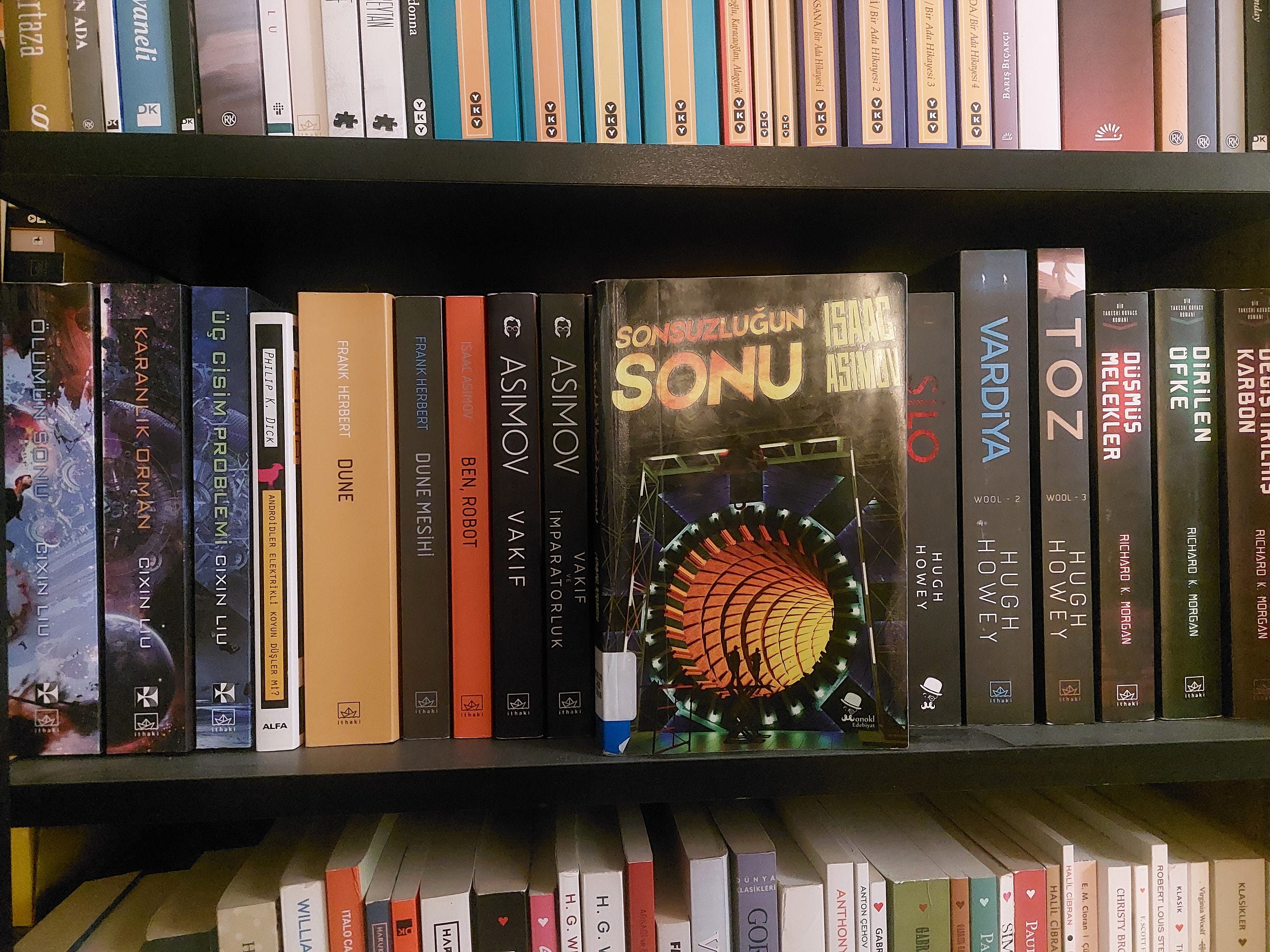
Picture by Author.
My personal opinion (and one shared by many friends in the book club) is that 1984 is simply the better book. It’s more grounded, more confident in its voice.
Long story short: Asimov read 1984 — which came out in 1949 — got a little obsessed (he already had a thing for space), and thought: “I’ll write the space version of this.” So he sat down, typed away like crazy… And well — this is what we got.
Conclusion: Mind Control vs. Time Control
1984 takes place in a darker, more political, and more didactic world. The End of Eternity is more metaphysical, more romantic, and dives into the philosophy of time. But in the end, both ask the same question: Where does the individual stand within the system?
Some of us try to stay human by protecting our thoughts. Some of us fight for the right to choose our own time.
Asimov and Orwell wrote from different places, with different worries… Yet their stories lead us to the same point: Who controls reality? And when can we truly be ourselves?
In The End of Eternity, Asimov’s loudest question is:
If everything is already planned, what’s the point of being human?
And here’s my answer:
Real Eternity is hidden in our right to choose our own path.
To make mistakes, to love, to be wrong…
Maybe the most human thing is this — not being under control.
To check out the other posts in the series, click here:
Frequently Asked Questions
▸What is The End of Eternity about?
Published in 1955, The End of Eternity is one of Asimov's most philosophical and romantic works. It follows an organization called Eternity that travels through time to make 'Micro-Changes' to history, optimizing humanity's path — but at the cost of human freedom and potential.
▸How does The End of Eternity connect to Asimov's Foundation universe?
The events in The End of Eternity are presented as a precondition for the creation of the Foundation universe. The novel ends with the line 'The end of Eternity is the beginning of Infinity,' signaling this transition.
▸What do The End of Eternity and 1984 have in common?
Both novels feature cold, bureaucratic institutions that control reality — one manipulates time and history, the other manipulates minds and facts. They both use love as a form of awakening against the system, and both explore how knowledge and language are restricted to maintain power.
▸How does control work differently in the two novels?
In 1984, control is enforced through surveillance, psychological manipulation, and rewriting records. In The End of Eternity, control is more refined — societies and historical events are physically altered through time travel, making the manipulation structural rather than personal.
▸How does love function as rebellion in both books?
In both novels, a romantic relationship becomes the character's first act of defiance against an oppressive system. Love gives the protagonist someone to act with and think alongside — a human connection the institution tries to eliminate.
▸What is the biggest difference in tone between the two novels?
1984 ends in total defeat and is designed to feel hopeless and cautionary. The End of Eternity carries a spark of hope — one person's actions can rewrite history and unlock a future full of possibilities, making it more philosophical and even romantic in tone.
▸How do the two books treat technology differently?
In 1984, technology is purely a tool of oppression — surveillance and control. In The End of Eternity, technology like time travel is portrayed as fascinating but morally complex, raising questions rather than simply serving power.
▸What is the Micro-Change Theory in The End of Eternity?
Micro-Change Theory is the method Eternity uses to alter history — making small, calculated adjustments to events in order to steer humanity toward statistically 'better' outcomes, without people in the timeline ever knowing changes were made.
▸What is the central philosophical question Asimov asks in The End of Eternity?
Asimov's loudest question is: if everything is already planned and optimized, what is the point of being human? The novel challenges whether a safe, managed existence is worth sacrificing genuine human agency and potential.
▸What are some sci-fi elements unique to The End of Eternity?
The novel features concepts like Physiotime, Time Kettles, Human Computers, and the Institution of Eternity itself. It also includes a moment where a character meets themselves — the closest the book comes to a classic time paradox.
▸How does individual action differ between the two stories?
In 1984, the protagonist's rebellion is ultimately crushed and changes nothing. In The End of Eternity, one person's choices genuinely rewrite history and open up a new future, giving individual action real weight and consequence.