Stop Numbing Yourself With Instagram Reels and Youtube Shorts
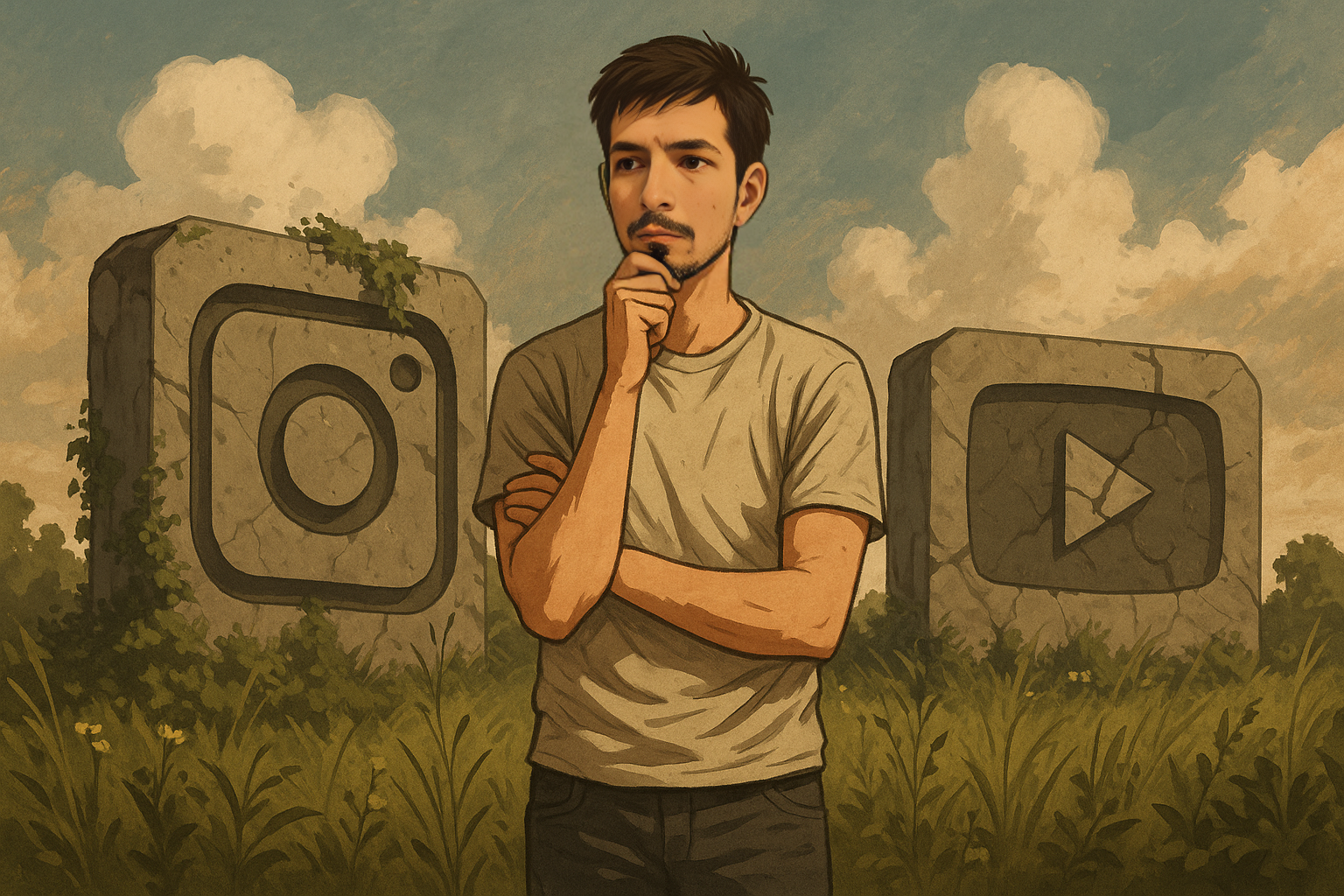
The image was generated by ChatGPT, and the face swap was done using Remarker.
I seriously don’t want to watch anything anymore. I mean it. I open YouTube, look at the titles, and just sigh:
“This one’s just like the other.”
“Clickbait again.”
“Saw this exact title yesterday.”
“Watching this video will totally change how we eat…” Yeah right. You’ll just tell me to eat more salad.
“Buy the product first, then make it…” Dude, how many times I saw this title?
Then I think, “Okay, someone else filmed this, maybe it’s a new angle.” I hit play. I watch for 15, maybe 20 seconds… and yep, just what I thought. Even the stuff that used to make me laugh or help me relax now just feels… familiar.
Even the funniest cat videos are boring now. Same look, same music, same setup. Most are scripted, some are montage, some even made by “AI”…
I don’t feel like checking social media either. I’ve never been the kind of person who scrolls non-stop. I honestly don’t get why people do it.
I open Instagram. My family and close friends are in my Favorites list. I check what they’ve shared, leave a like, see how they’re doing… and when I’m done, I close the app in minutes.
I’ve got nothing to do with TikTok. Like I said in the post below, I only made an account to download a video from a Haluk Levent concert. That’s it.
Same filtered faces, same “perfect” lives, same poses… It’s like everyone came out of the same mold. These days, there’s almost nothing I actually enjoy watching.
Nothing feels new.
Nothing surprises me.
Nothing makes me go, “Wow.”
And that makes me think.
Is the problem with the content?
With the algorithms?
Or… is it me?
Does Everyone Feel This Way about Youtube and Instagram?
Nope. Because some people are still under the spell of those too good algorithms. They can still get lost in endless scrolling.
They don’t even realize that half an hour flew by while watching Reels.
To them, everything still feels “new,” still “fun,” still “mind-blowing.” Because they’re not full yet.
But the point isn’t really “having fun.” It’s dopamine — those quick hits your brain gives you to feel good. Every scroll, every fast video turns the dopamine tap up a little more. And your brain stops caring about quality — it just wants the kick. Is the content actually good? Nope. But it’s fast, flashy, and easy to consume. In short: dopamine bait.
That’s why someone can see the same thing 20 times and still not get bored. Because their brain isn’t looking for good stuff anymore.
It’s looking for stimulation.
And no, don’t worry — this isn’t another one of those “here’s why dopamine is bad” posts. Ugh, even thinking about those content makes me sick…
But here’s the truth: This mood catches up with everyone.
Because once you see the same thing for the thousandth time… The same look, the same joke, the same “Things You Didn’t Know About X” headline…
Just f*ck off.
You either grow tired of it all, or you start chasing even dumber, even simpler content. And that’s a darker hole.
But if you:
Look at video titles and think “nah, skip it,”
Feel like you’ve seen the same clip three times already,
Watch something and ask yourself, “Why did I even watch this?”
Congrats. You’ve got a selective mind now. That discomfort you feel? It’s the side effect of an evolved awareness. Because in a world where everyone gets used to everything…
The real danger is forgetting who you are.
Who Feels This the Most?
People who understand how algorithms work.
People who notice things.
Those who’ve fed their minds with quality content before.
People who’ve trained their brains to think and analyze.
People who live with a mindset of creating, not just consuming.
Those who ask, “What did this content give me?” after everything they watch.
People who can tell the difference between genuine interest and plain old addiction.
None of this happens by accident. This feeling of being burnt out — it’s not weakness. Most of the time, it’s a sign of awareness.
I think we’ve talked enough about this whole syndrome. You get me.
And if you’re reading this instead of some cringe “How I made X amount from blogging” or “Why nobody reads your posts” or “How to earn Y in a month by writing” clickbait garbage — then yeah, you’re in the right place. You are going through this too.
And because I’m someone who prefers living a proactive life, I don’t just bring problems to the table — I bring solutions, too.
So What Am I Doing About It?
Honestly? Letting go of habits isn’t easy. Really — I mean it. I’m no expert. In this part, I’m just sharing what personally worked for me.
Note: If not being able to quit social media starts to seriously bother me, and these simple methods don’t help, I’ll definitely talk to a psychologist. No shame in that. And if even that doesn’t help — if my brain can’t stop even when I tell it to — then maybe the problem is deeper.
Maybe my brain just isn’t doing its job properly. Like, if I want to clench my fist and my hand doesn’t move, I’d run to the hospital, right? So if my brain isn’t working right, I’m not afraid to get psychiatric help either. But for now, here are the simple things I try:
I shut it down. Really. My hand still reaches for my phone sometimes without intention. But I tell myself, “Am I really going to fall into this trap again? I’m stronger than this.” And I put it down — sometimes without even turning on the screen. Sometimes I do wake the screen, but if there’s nothing important, I turn it off and leave it.
Speaking of notifications — it’s super important to cut those down. I mean, do I really need a “Today’s top Reels” notification? Just because a random crowd watched something doesn’t mean I have to. If someone sends a message — sure, get that. But don’t let sales alerts and promo pings pull your focus. You know it, my enlightened reader. There are always campaigns and the product is never sold at the price tag. Unnecessary notifications are the easiest way to break your focus.
I didn’t force myself to quit YouTube or Instagram. They just started feeling meaningless. Like I said from the start — they slowly started making me feel sick. (And no, I’m not pregnant…)
At one point, I just stared at a blank wall.
Then I thought: This emptiness isn’t bad… it’s actually good.
My mind went quiet. I felt calm.
Remember boredom? Yeah, I missed that.
Now, I don’t try to fill every moment.
Not constantly consuming things doesn’t make life dull.
Actually, it makes it better. I can focus more easily. I watch less, but I enjoy it more. I’m not afraid of silence. I’m fine being alone with my thoughts.
By slowing down like this, I’m also kind of escaping that “can’t keep up” syndrome. You know what I mean — the more you learn, the more you realize how much more there is to learn, and you start feeling like you’re falling behind. Chill. Really. You don’t have to learn and use everything right away. (I see this a lot with developers especially.)
I’m not always creating. But at least — I’m not constantly consuming, either. And honestly? That alone feels pretty damn good.
When Was the Last Time You Were Truly Surprised?
Ask yourself that. When was the last time you said, “Wow!”?
When did something you watched move you, make you think, or truly make you smile?
When was the last time you told a friend, “You HAVE to watch this”? When did you ever pause a video halfway through and just… think?
If your answer is “I don’t remember,” the problem is not you. Really, it’s not. Because content today doesn’t try to move you. It just wants to show you. It shouts. It flashes. It sparkles. But it doesn’t make you think.
There’s no depth.
It doesn’t ask anything from you.
Not to grow, not to reflect, not to remember…
It just wants you to feel like you felt something. But that feeling? It fades. And what’s left behind is just… emptiness. And in that emptiness, you realize something’s missing.
What’s missing is: realness.
Real emotion. Real learning. Real wonder.
And maybe that’s why — you finally close it all. And maybe… just maybe… you start coming back to yourself.
What Do the Algorithms Say About This?
I did wonder if the algorithms keep showing me the same kind of content. I mean, this is YouTube — thousands of new videos uploaded every minute, people sharing totally different things every second… So why does my homepage and explore tab feel like it’s stuck in a loop? Same tone of voice, same “shocking fact” titles, same fast cuts. Did I forget how to search, or has the algorithm trapped me in its little circle?
Maybe both. Maybe at some point, I started spinning right in the center of that circle too. What I liked used to match me — but what I see now doesn’t anymore.
At first, algorithms pretend to get to know you. Then they lock you into your own habits. Without you noticing, they shrink the variety and keep stacking similar things one after another — turning it into a kind of digital echo chamber. And one day, you suddenly ask:
“Why do I keep watching the same stuff?”
The answer is actually simple:
These platforms don’t care what you want — they care what keeps you watching longest.
They don’t optimize for content. They optimize for addiction. And that’s exactly why this disgust creeps in. While you’re still thinking “What should I watch?”, the algorithm has already decided “Here’s what you’ll watch.”
That’s why I made a brand-new YouTube account with a different email. And honestly? It was even worse. At least the old one kind of knew what I liked. The new one? Pure trash.
Conclusion: The Problem Isn’t Me. It’s the Content
I thought I was burnt out.
Turns out, I was just full.
The problem wasn’t me; it was the same content, showing up again and again in a different package.
I don’t watch anymore because I don’t believe anymore.
And this emptiness I felt… maybe it’s not really empty.
Maybe this is the fullest I’ve ever been.
Maybe I see more when social media is off.
Frequently Asked Questions
▸Why do Reels and Shorts feel so repetitive and boring after a while?
Algorithms serve content optimized for clicks and watch time, not originality. This creates a loop of recycled titles, formats, and hooks that start feeling identical after enough exposure. Your brain eventually stops finding novelty in content that was never truly novel to begin with.
▸What is dopamine bait in the context of short-form video?
Dopamine bait refers to content designed to trigger a quick reward response — clickbait titles, dramatic hooks, and shallow payoffs — that keeps users scrolling without delivering real value. It exploits the brain's reward system rather than offering genuine information or entertainment.
▸Is it normal to feel disgusted or tired of scrolling through Reels and Shorts?
Yes, and the post frames it as a positive sign. Feeling burnt out on repetitive short-form content suggests your pattern recognition has caught up to the manipulation. It means you're no longer easily fooled by the same recycled hooks.
▸Who is most likely to feel burnt out on short-form video content?
The post implies that people who consume a high volume of Reels and Shorts are the most prone to this fatigue. Heavy users eventually recognize the patterns — the same title structures, the same product plugs, the same 'life-changing' promises — and disengage.
▸Is the problem with how I use social media, or with the content itself?
According to the post, the problem is the content, not the viewer. Platforms and creators optimize for engagement metrics, which incentivizes repetitive, low-effort dopamine bait rather than meaningful or surprising content.
▸What does it mean when you can predict a video just from its title?
It means the content has become formulaic enough that your brain has internalized the pattern. When titles like 'This will totally change how we eat' or 'Buy it first, then make it' all blur together, the novelty that drives engagement has worn off completely.
▸What should you do when you feel numb from watching Reels and Shorts?
The post suggests recognizing the feeling as meaningful rather than ignoring it. The author's response is to stop forcing consumption and question what genuinely surprising or valuable content even looks like anymore — treating the numbness as a signal to change habits.
▸How do algorithms contribute to the feeling of content burnout?
Algorithms prioritize content that maximizes clicks and watch time, which rewards creators who use proven hooks and formats over those who take creative risks. This feedback loop floods feeds with similar content, accelerating viewer fatigue.