The Surprising Truth About What Motivates Us I Read the Famous Book “Drive”!
- Lost in the Shadow of Unnecessary Details
- Introduction: The Evolution of Motivation and the Changing Work World
- Chapter 1: A New Operating System
- 1. Motivation 1.0: The Primitive Era
- 2. Motivation 2.0: The Industrial Revolution & The Reward-Punishment System
- 3. Motivation 3.0: The Age of Inner Motivation
- Autonomy: The Freedom to Make Your Own Choices
- Mastery: The Desire to Keep Getting Better at Something
- Purpose: Feeling That What You Do Actually Matters
- Chapter 2: Seven Reasons Why the Reward-and-Punishment System (Usually) Doesn’t Work
- 1. Rewards Undermine Intrinsic Motivation
- 2. Rewards Reduce Performance
- 3. Rewards Crush Creativity
- 4. Rewards Can Encourage Unethical Behavior
- 5. Rewards Promote Cheating and Shortcuts
- 6. Rewards Can Become Addictive
- 7. Rewards Encourage Short-Term Thinking
- Chapter 3: Type I and Type X — How People Stay Motivated
- Type X (Extrinsically Motivated Individuals)
- Type I (Intrinsically Motivated Individuals)
- Is It Possible to Shift from Type X to Type I?
- Conclusion: The Power of Intrinsic Motivation and the Future of Work Culture
Contents
- Lost in the Shadow of Unnecessary Details
- Introduction: The Evolution of Motivation and the Changing Work World
- Chapter 1: A New Operating System
- 1. Motivation 1.0: The Primitive Era
- 2. Motivation 2.0: The Industrial Revolution & The Reward-Punishment System
- 3. Motivation 3.0: The Age of Inner Motivation
- Autonomy: The Freedom to Make Your Own Choices
- Mastery: The Desire to Keep Getting Better at Something
- Purpose: Feeling That What You Do Actually Matters
- Chapter 2: Seven Reasons Why the Reward-and-Punishment System (Usually) Doesn’t Work
- 1. Rewards Undermine Intrinsic Motivation
- 2. Rewards Reduce Performance
- 3. Rewards Crush Creativity
- 4. Rewards Can Encourage Unethical Behavior
- 5. Rewards Promote Cheating and Shortcuts
- 6. Rewards Can Become Addictive
- 7. Rewards Encourage Short-Term Thinking
- Chapter 3: Type I and Type X — How People Stay Motivated
- Type X (Extrinsically Motivated Individuals)
- Type I (Intrinsically Motivated Individuals)
- Is It Possible to Shift from Type X to Type I?
- Conclusion: The Power of Intrinsic Motivation and the Future of Work Culture


Meaningful achievement depends on lifting one’s sights and pushing toward the horizon.
So, I’ve been a manager for a while now — and as you know, I’m kinda obsessed with being a really good one. I mentioned this in a few of my past posts too. This first post is not technical and flows easily. Some of the others do dive into technical stuff, but feel free to skip those parts — they’re still fun to read! My editor (and also my wife!) Nare puts in a lot of effort so everyone can enjoy reading these. So here we go:

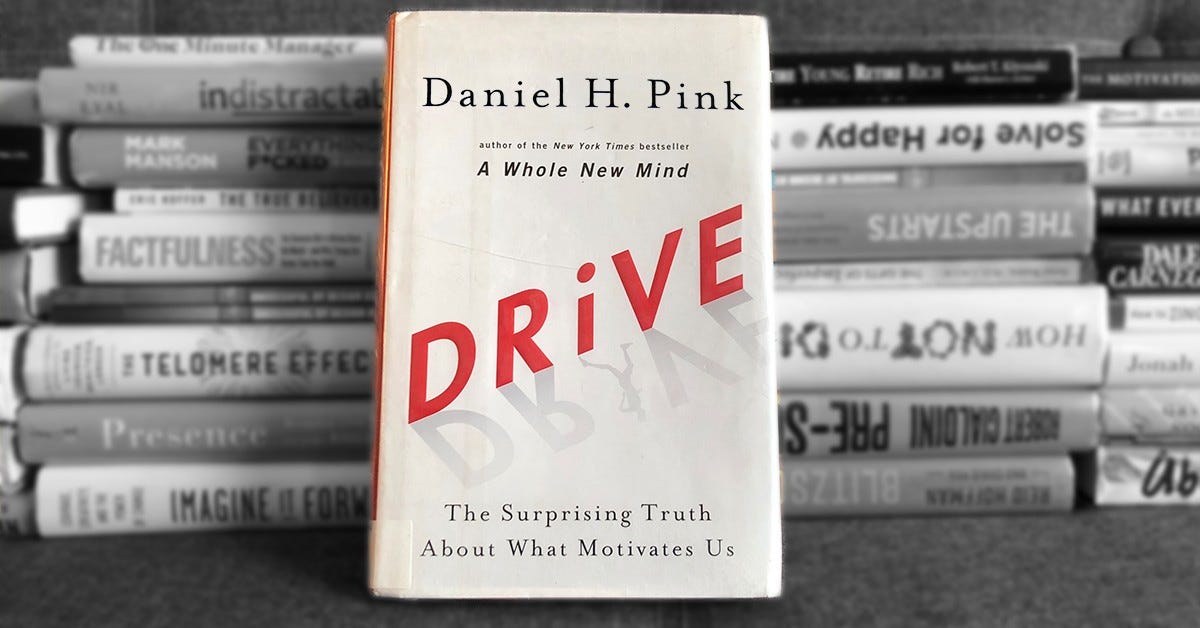
So, after I started looking into books about leadership, one of the books that popped up was Drive. I went straight to Atatürk Library, where my wife works, borrowed it, and started reading right away with my Sumatra coffee. You probably know it — it’s one of those books that’s super popular, highly praised, and well-loved.
In this post, I’m going to talk about Drive by Daniel H. Pink. Let’s get started!
Lost in the Shadow of Unnecessary Details
If you think you’ll open the book and immediately find the answer to “What motivates people?”, well, not quite.
There’s something that often happens in psychology or self-improvement books, dear reader — and I bet you’ve seen it too, since you’re someone who reads a lot: To support the main idea, they throw in examples that turn into full-blown biographies of people who don’t even matter that much to the point.
Like, instead of just explaining a simple leadership idea, the author dives into a CEO’s childhood, the schools they went to, their teenage hobbies, and their whole career path — in full detail.
These parts totally pull you away from the main topic and make the book lose its focus. Honestly, if the writer just gave shorter and more direct examples, it’d be way more helpful and interesting.
Because of these dragged-out parts, I lost all my motivation to read the book. It took me six or seven months to finish it — and for me, even a week feels like too much. So yeah, you can probably guess how much I hate cliché biographies 😅
I don’t think I’ll read another self—improvement book by an American author anytime soon. Even if I have to, I’ll just skip those parts.
Introduction: The Evolution of Motivation and the Changing Work World
The book starts by building a bridge between the old and new ways of thinking about human motivation. Just like I mentioned (and complained about) earlier, the intro goes into long stories — high school, college years, how people met, their experiments…
Finally, it gets to the point: through the research of psychologists Harry Harlow and Edward Deci, we learn that people aren’t just motivated by basic needs (like hunger, thirst, or sex) or external rewards (like money or praise). The book uses lots of examples and experiments to show this — and Deci’s studies get a lot of page time.
One of the key experiments that supports this idea is called the Soma Puzzle Experiment, and the book gives it a big spotlight. Here’s the short version: People are given a puzzle to solve. The first group gets no reward — they’re just told to solve it. The second group gets a reward for doing it.
Later, when the rewards are taken away, the group that used to get paid loses interest. Basically, money kills the joy of doing an activity just for fun.
This is one of the most important points in Pink’s book. According to him, if you want to truly motivate people, don’t try to control them, don’t drown them in money, and don’t use fear. Instead, create a space where they can grow their inner motivation.
And by the way — when Pink says “don’t drown them in money,” he also makes it clear that people should be paid fairly. But once they are, any extra cash only boosts motivation for a short time.
Chapter 1: A New Operating System
In this part, Pink breaks down the history of motivation into three phases, matching how humanity has evolved over time. He brings a bit of a philosophical angle here, but the main idea is super clear: What motivates us has changed a lot throughout history.
He talks at length about what motivation really is, how we can help people love what they do, and why today’s systems just don’t cut it anymore.
1. Motivation 1.0: The Primitive Era
This was all about survival. “Stay alive, get your food” kind of mindset. People were driven by basic instincts — to eat, drink, and reproduce. We hunted so we wouldn’t starve, ran to stay alive. Back then, there was no modern society or work life. This system made sense because, well, there really weren’t any other options.
2. Motivation 2.0: The Industrial Revolution & The Reward-Punishment System
This one’s based on external control: rewards and punishments. It worked really well for repetitive and routine jobs, especially after the industrial revolution in the early 20th century.
But here’s the catch — we don’t live in that world anymore. Our work today is more complex, more creative… and this system just doesn’t work as well now.
Pink goes into a lot of detail on why this system is no longer enough — and I totally skipped most of that just for you. Since I gave you this neat little info snack (can’t say pill, it’s kinda long), go ahead and smash that clap button now 😄👏
With the industrial revolution, capitalism and the business world stepped into our lives. People were no longer working just to survive — now they wanted to earn more. That’s when employers started asking, “How can I make my workers do more?” The solution? The reward and punishment system.
According to this logic:
Reward → Makes people work harder (like salary, bonuses, praise, awards)
Punishment → Keeps people in line (like fear of being fired, low pay, warnings)
This system worked well during the 20th century, especially in factories, companies, and government offices. Why? Because most jobs were simple and repetitive:
“Tighten these screws, press these buttons, fill these bottles.”
For tasks like these, rewards and punishments did the trick. People woke up every morning and went to work to earn their paycheck.
But here’s the problem: for creative or brain-heavy work, this system is a total disaster.
There’s an example in the book I can never forget — and I probably never will: Microsoft vs. Wikipedia.
Microsoft created a digital encyclopedia called Encarta. The people working on it were paid to produce content.
At the same time, Wikipedia was being built completely by volunteers. No one got paid, but people still added articles because they wanted to.
The result? Microsoft Encarta shut down. Wikipedia has become the biggest encyclopedia in the world.
So yeah, when it comes to creative work, money isn’t always the biggest motivator.
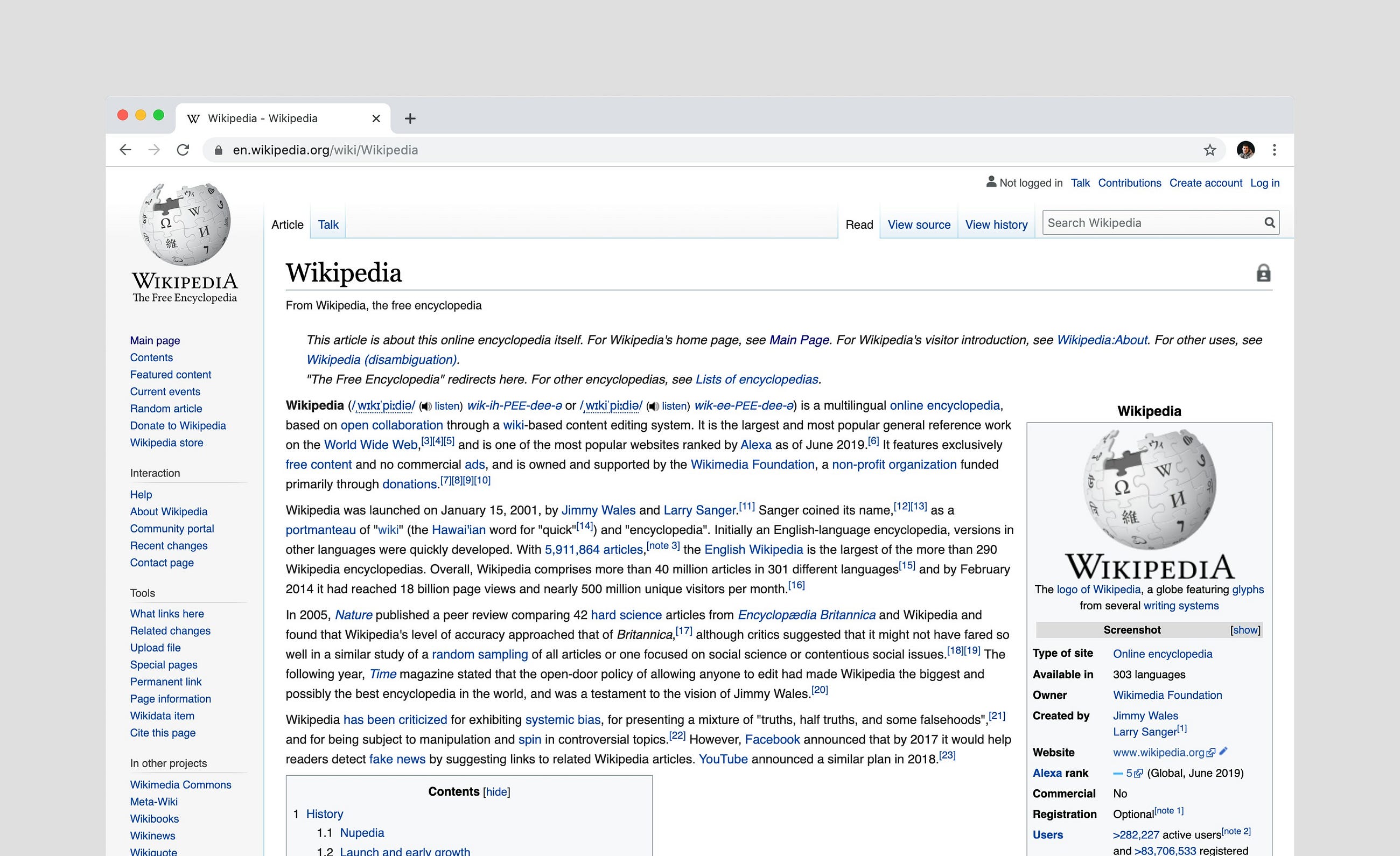
Photo by Luke Chesser on Unsplash
3. Motivation 3.0: The Age of Inner Motivation
According to Pink, many of today’s jobs need thinking, analyzing, and being creative. So just saying, “We’re paying you this much, now go do your job” doesn’t cut it anymore.
People want to find meaning in what they do. They want freedom, mastery, and purpose. And that’s where the three big ideas in Pink’s book come in:
Autonomy: The Freedom to Make Your Own Choices
People want some control over how, when, and in what way they work — especially if they want to feel connected to their job. In old-school management, every little detail is told to the worker, and everything is tightly controlled. But this kills motivation and creativity.
When people have autonomy, they take more ownership of their work. Their inner motivation grows, and they become way more productive.
Mastery: The Desire to Keep Getting Better at Something
We naturally feel more motivated when we see ourselves growing and improving.
Jobs that are repetitive and offer no room to grow can burn people out quickly. But when a job gives us the chance to learn and get better, it becomes much more satisfying over time.
Mastery isn’t just about working more — it’s about getting better at what we do, learning new skills, and pushing ourselves forward. That feeling of progress? That’s where real motivation comes from.

Photo by Jason Hogan on Unsplash
Purpose: Feeling That What You Do Actually Matters
People don’t just work to make money or to finish tasks. They want to feel like what they’re doing means something.
One of the biggest things that motivates people is feeling like they’re part of a bigger picture. When workers believe their job helps society, humanity, or a mission — not just a company’s profit — they become way more committed and give deeper meaning to their work.
One of the best examples in the book is Google’s 20% Time Policy:
Google lets employees use 20% of their time to work on any project they want.
The result? Products like Gmail, Google Maps, and Google Drive were all born from this “free time.”
So yeah, when people are given freedom, they become more creative and more productive.
At ING Turkey, we had 3 performance goals. One was the job we were already doing, one was a big new personal goal for the year, and the third was a side project that helped the company.
Every sprint, we saved time for these special side-projects — and worked on them together. And if you’re sitting there thinking, “Wait, what’s a sprint?” — feel free to check out my Scrum posts 😉
That’s why in today’s modern work world, it’s not enough to just offer people a salary or a bonus — you need to help them actually enjoy what they do.
Chapter 2: Seven Reasons Why the Reward-and-Punishment System (Usually) Doesn’t Work
In this chapter, Daniel Pink goes deep into why the old-school reward-punishment system (Motivation 2.0) just doesn’t cut it in today’s world of work. He explains that while rewards and punishments might work in the short term, they often backfire in the long run.
But honestly? If you ask me, this whole chapter could’ve been skipped. I mean, I just became a manager — and even I know that the reward-and-punishment game isn’t the best way. I already try to keep my team motivated by recognizing what they do, not by dangling bonuses over their heads.
So yeah, I was like, “Come on, Daniel… just move on!”
Still, I powered through it — just in case someone ever asks me about this system, now I’ve got something smart to say 😅
Pink lists seven reasons why rewards and punishments don’t work — especially when it comes to creativity, problem-solving, and long-term success.
I even took notes (yep, I didn’t get lazy). Here they are — go ahead and read:

Photo by Alexander Dummer on Unsplash
1. Rewards Undermine Intrinsic Motivation
When people do something because they enjoy it or care about it, external rewards (like money, bonuses, and prizes) can actually kill that joy. If you’re doing a task because it feels meaningful to you — and suddenly money gets involved — your reason for doing it shifts.
Example: The MIT Students Experiment.
In this study, students at MIT were given math problems to solve. Some were offered a reward, others weren’t.
The ones who didn’t get a reward kept going, even wanted to solve more problems.
But the ones who were rewarded? Once the reward was gone, they lost interest — even got bored.
2. Rewards Reduce Performance
Classic economic theory says that rewards increase motivation. But for creative or brain-heavy work, that’s not really true.
If you offer big rewards for work that requires fresh ideas or problem-solving, people tend to avoid risks. They stop experimenting. They just focus on the result, not the process — and that lowers quality.
Example: Real Life
Let’s say a company ties a software manager’s bonus to how much the sales team sells. Now the manager’s only focus becomes “just ship the product” — even if the code is messy, rushed, or poorly designed. The team gets frustrated. They don’t want to touch that code ever again.
When people work under reward pressure, their thinking becomes narrow. They struggle to come up with new ideas. It turns into: “Let me just finish this thing first, then we’ll talk.” But that “talk” never really happens.
Example: Glucksberg’s Candle Problem Experiment
In this famous study, participants were given the candle problem — a creative thinking challenge. One group was offered money if they solved it quickly. The other group got no reward at all. Surprisingly, the group with the reward took longer to solve the problem. This showed that rewards can actually slow down performance — especially in tasks that need creative thinking.
3. Rewards Crush Creativity
Just like in the last point, rewards make people play it safe. They start thinking, “What’s the safest way to get the reward?” Instead of wild or fresh ideas, they go for the guaranteed ones. But when people focus on the process — not the prize — creativity flows. With rewards, it turns into: “Let me win the prize, who cares about the rest?”
Example: Amabile’s Research
Professional writers were split into two groups. One group was told they’d get a reward for their writing. The other group got no such info. Later, independent judges rated the work — and guess what? The writers expecting a reward were seen as less creative.
4. Rewards Can Encourage Unethical Behavior
When people act just for the reward, they’re more likely to bend the rules. Why? Because the goal shifts from “doing a good job” to “just get the prize.” If you only give short-term rewards, you might end up causing long-term damage.
Example: Gneezy & Rustichini’s Study
In an Israeli preschool, parents who picked up their kids late started getting fined. But instead of being discouraged, more parents started coming late. Why? Because the fine made it feel like they were simply paying for the extra time — not doing something wrong.
5. Rewards Promote Cheating and Shortcuts
The reward system doesn’t encourage doing what’s right — it just pushes people to win. Like I said in the last point, people might start cheating just to get the reward. If you only focus them on the prize, they’ll look for shortcuts and might even abuse the system.
Example: Kohn’s Observation
Reward and punishment systems can lead people to unethical choices. For instance, employees under sales pressure might lie to customers just to hit their targets.
6. Rewards Can Become Addictive
Rewards can be addictive. Over time, people lose the ability to work without them. They start thinking, “Why should I do this if there’s no reward?” If rewards become a habit, people won’t work unless they get something in return.
Example: If you give your kid money every time they study, they’ll stop studying unless you pay them. The reward becomes a habit, and they lose their inner motivation.
Deci’s Observation: External rewards can create dependency — and when the reward disappears, so does the motivation.
7. Rewards Encourage Short-Term Thinking
Like I said before, rewards usually focus on short-term wins, not long-term success. People start chasing quick results instead of sticking with bigger, long-term goals. Rewards push for fast achievements, but they also make people ignore long-term planning. This can stop both companies and individuals from making smart, future-focused decisions.
Example: The 2008 Global Financial Crisis
In the U.S., big banks told their managers, “The more mortgage loans you sell, the bigger your bonus.” So, bank employees started giving loans even to risky clients — just to boost their own bonuses.
You probably know how that turned out. The unpaid loans piled up, the system collapsed, and the world faced a huge financial crisis. (Oops, I forgot — it barely touched us, right? Hope the finance police aren’t reading this 😅) Managers focused on their short-term gain, but in the long run, it hurt the companies — and the whole economy.

Photo by Vince Fleming on Unsplash
Chapter 3: Type I and Type X — How People Stay Motivated
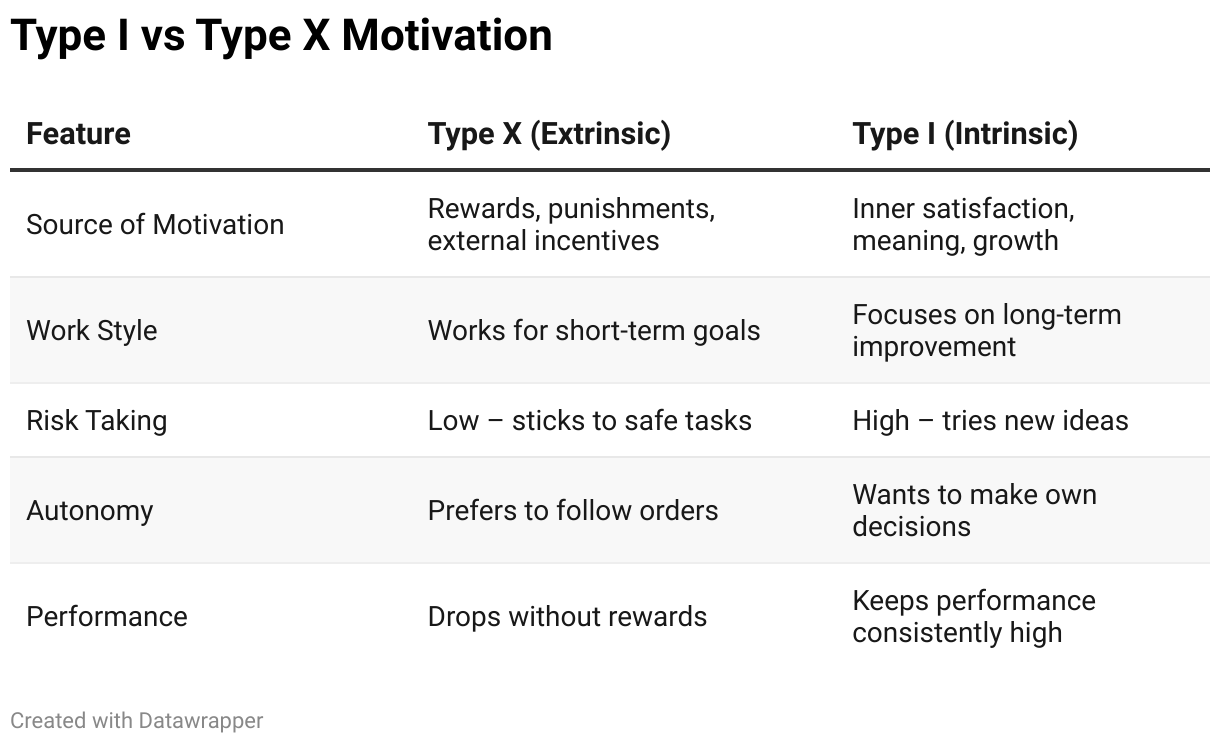
Daniel Pink breaks people’s motivation styles into two main types:
Type X (Extrinsically Motivated)
Type I (Intrinsically Motivated)
These two types shape how people approach work, what drives them, and how they perform over time.
According to Pink, the old world built on Motivation 2.0 (the reward-punishment model) created Type X people, while the new Motivation 3.0 system (focused on inner motivation) supports and grows Type I people.
So, what’s the difference between the two? Let’s break it down:
Type X (Extrinsically Motivated Individuals)
These folks are driven mainly by external rewards. If there’s no salary bump, promotion, or prize, they don’t feel motivated. They chase short-term wins and avoid risk. They don’t care much about whether they like the job — as long as it pays. Many companies keep their people in this mindset with bonus systems and performance reviews. But the problem is: once the rewards disappear, so does the motivation. These people usually struggle to achieve long-term success.
Type I (Intrinsically Motivated Individuals)
These are the people who do what they do because they love it, want to improve, and are looking for meaning. They care less about rewards. Think of open-source developers, artists, scientists, or entrepreneurs — most of them have strong Type I energy. What moves them isn’t money or prizes but the desire to grow their skills and do something meaningful. In the long run, they tend to be more successful — because for them, work isn’t just a job. It’s a passion.
Is It Possible to Shift from Type X to Type I?
According to Pink, if you want to succeed in today’s work world — especially in creative fields — making the shift from Type X to Type I is a must. He also believes that anyone can become Type I. Because Type I isn’t something you’re born with — it’s a skill you can develop over time.
Sure, rewards and punishments might work in the short term, but they don’t last. People driven by inner motivation get better at what they do, come up with fresh ideas, and feel real satisfaction from their work.
That’s why both individuals and companies should stop feeding the reward addiction — and instead build systems that boost autonomy, mastery, and purpose.
📌 3 Steps to Become More Type I:
Focus on meaning, not rewards → Your work should have a purpose.
Try to gain autonomy. → Expand the areas where you make the decisions.
Aim for mastery → Keep improving and getting better at something that matters to you.
Conclusion: The Power of Intrinsic Motivation and the Future of Work Culture
Daniel Pink’s Drive gives us a strong framework to understand motivation and succeed in today’s work world. The old Motivation 2.0 model — based on rewards and punishments — just isn’t enough anymore.
In today’s world, we need to shift toward Motivation 3.0 — a mindset that supports creativity, problem-solving, and long-term success.
Autonomy, Mastery, and Purpose are the three key factors for real and lasting success — for both individuals and organizations. When people are free to choose how they work, supported in getting better at what they do, and feel that their work actually matters, that’s when real motivation kicks in.
If you’re a manager, don’t rely only on money or rewards to keep your team motivated.
If you’re an employee, don’t just work for the paycheck — work for the meaning behind what you do.
Because long-term success and real satisfaction don’t come from the outside — according to Pink, they come from within.
Shifting from Type X to Type I isn’t just about personal growth — it’s about building a more creative, innovative, and sustainable work culture.
So the real question isn’t “How can I make people work harder?” It’s: “How can people enjoy what they do and create better work because of it?”
That’s where real success lives. 🚀
Frequently Asked Questions
▸What are the three types of motivation Daniel Pink describes in Drive?
Pink outlines Motivation 1.0 (primitive survival), Motivation 2.0 (industrial-era reward-and-punishment), and Motivation 3.0 (inner, intrinsic motivation). He argues we need to move beyond 2.0 to thrive in modern work environments.
▸What are the three pillars of intrinsic motivation in Drive?
Pink identifies Autonomy (the freedom to make your own choices), Mastery (the desire to keep improving at something), and Purpose (feeling that your work genuinely matters). Together these form the core of Motivation 3.0.
▸Why don't rewards and punishments work according to Daniel Pink?
Pink lists seven reasons: rewards undermine intrinsic motivation, reduce performance, crush creativity, encourage unethical behavior, promote cheating and shortcuts, can become addictive, and push people toward short-term thinking rather than long-term goals.
▸What is the Soma Puzzle experiment mentioned in Drive?
The Soma Puzzle experiment is a key piece of research Pink references to show that external rewards can actually undermine intrinsic motivation. When people were paid to solve puzzles they previously enjoyed for free, they became less motivated to continue once the reward was removed.
▸What is the difference between Type I and Type X people in Drive?
Type X individuals are extrinsically motivated — driven mainly by external rewards like money or status. Type I individuals are intrinsically motivated — driven by genuine interest, growth, and purpose. Pink argues Type I behavior tends to produce better long-term results.
▸Can someone shift from being Type X to Type I?
According to Pink's framework in Drive, yes — the shift from Type X to Type I is possible. It's not a fixed personality trait but a behavioral pattern that can change given the right environment, management style, and conditions.
▸How does Drive apply to managers and leadership?
Drive is highly relevant for managers because it challenges the common use of bonuses and penalties to drive performance. Pink suggests that good management focuses on giving people autonomy, helping them develop mastery, and connecting them to a meaningful purpose.
▸Does Daniel Pink say money doesn't matter at all in Drive?
Pink doesn't say money is irrelevant — he acknowledges it needs to be fair and sufficient. But once basic compensation needs are met, additional monetary rewards often fail to boost motivation and can even harm intrinsic drive and creativity.