A Principal Who Made a Difference 4: You'll Not Have My Blessing
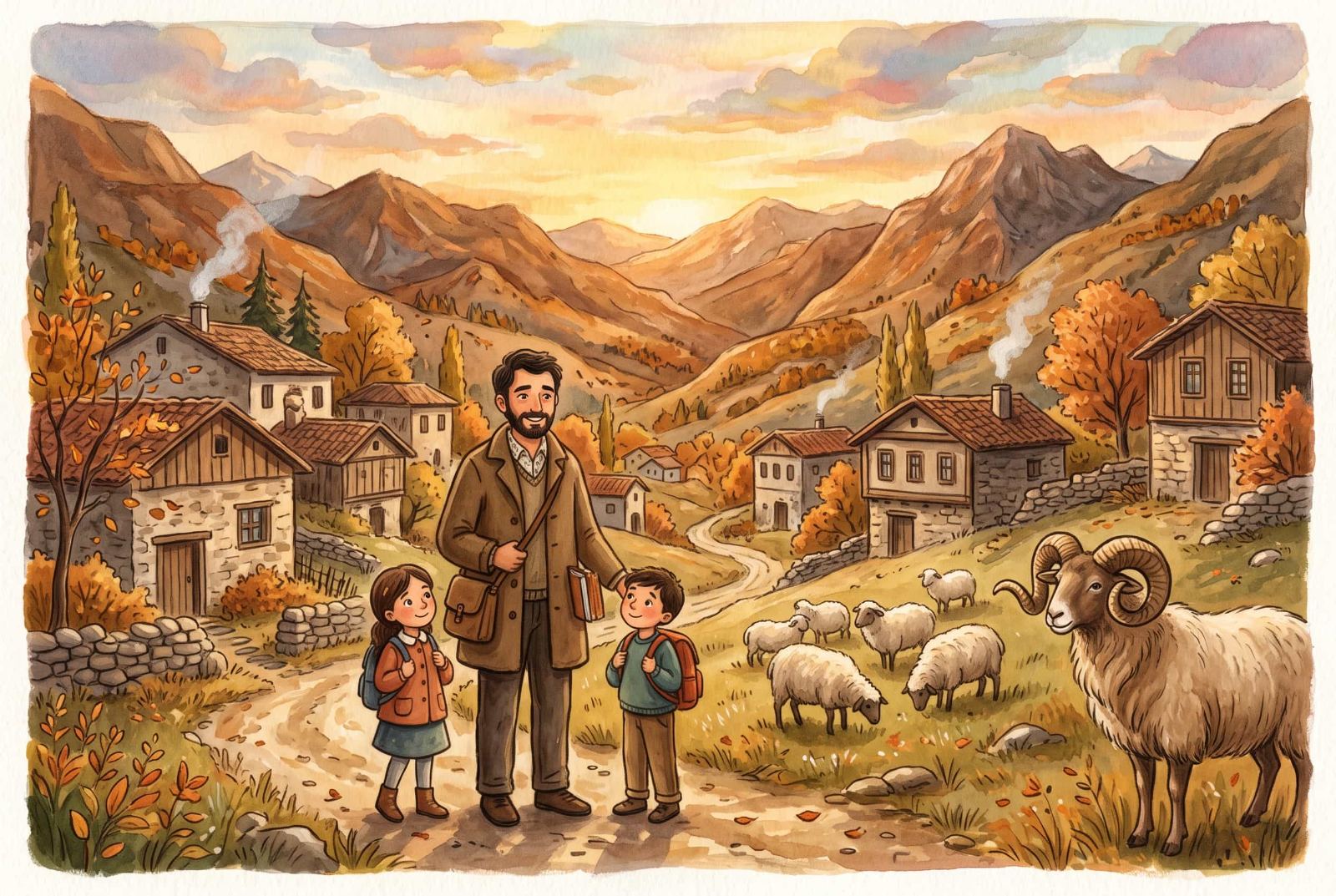
Image generated by Gemini
We opened the school in Kazancık in September and even taught for a few weeks. Then in October the training course came up. They were taking in every teacher in Turkey, group by group. Our official post never used to change for short trainings and courses, but because this one ran long, our post was transferred to Kınıklı village in Denizli.
When the transfer letter for Denizli came, a heaviness settled over me. But there was no time to grieve, no time to sigh over it. I had to finish the goodbyes quickly and get to the training center.
Of course it hurt to leave my students, and most of all to leave behind a friend as precious as Özdamar.
We went to Kahvepınar, our neighboring village. We were close with the headman of Kahvepınar, and with the teacher too. That teacher had worked in Develi before. He was very experienced, so I would go and get his advice from time to time. And the headman was forever inviting us over.
Özdamar and I went to see Brother Şahin, the village headman. We told him my transfer had come through and that we were leaving for the training center. Then we asked each other's forgiveness, said goodbye and went back to the village.
Asking for Blessings
Now we started going door to door through Kazancık, twenty-five houses in all, asking for their blessing. They forgave us and we forgave them. As it turned out, Mustafa Hoca was away from the village.
We started from the farthest house in the village, Brother Reşit's. Reşit, Reşit Temur, was a knowledgeable, well-mannered man. We made our peace with him standing at his door. Then Uncle Bilal, then Uncle Abdurrahman, all the well-known names of the village… We went in and out of every house.
At the very end we came to the house of Uncle Haydar, the brother of our headman Ramazan. There was usually a gathering at Uncle Haydar's house, and that was where people sat and talked. Uncle Haydar understood the livestock trade better than anyone. He had bought and sold animals all over Turkey. When I first arrived, I had stayed fifteen days as a guest in his house.
Anyway, just as we were about to leave, while we were exchanging our blessings, Uncle Haydar said to me:
“Teacher, I kiss your hands.”
“Heaven forbid, Uncle Haydar, what is this? What kind of thing is that to say?” I said.
“I spoke about you once at a gathering, somewhere you weren't.”
“What did you say?”
“I said, ‘A teacher has come to us that we could trust with our lives, our property, our honor, with everything, a teacher of solid character.' Then one of them said, ‘He's a bachelor, and a bachelor has neither faith nor shame… I can make him do anything.' So I said, ‘Go on then, make him do something wrong. If you do, I'll slaughter such-and-such ram of mine and give it to you as a gift.'”
They had made a bet over his ram. Of course I knew nothing about any such bet; I was only learning of it now.
The man he was talking about would come around, offer me drinks now and then, make improper suggestions. And I would say, "No, my friend, I came to this village to teach; I didn't come to pass the time or fool around."
When I said that, he would start up again: “That Özdamar before you was a difficult man too. He's married, true, but he doesn't drink, doesn't do anything wrong, no fun at all. You're a bachelor though, you're up for anything.”
And I would say, “No, brother, there is no such thing as being up for anything with us. Whatever the Quran says, that is the road we are on.” So I never once did what he wanted.
Of course, at the time I knew nothing about the bet. I learned it later from Uncle Haydar; in the end this fellow had lost. And Uncle Haydar had said to him: “I have traveled all of Turkey, I know people. I didn't vouch for this teacher for nothing. This man stayed fifteen days in my house. I read his morals, his character, very well. If it were up to us, we would never let him be sent anywhere.” After Uncle Haydar told me all this, he said, “Forgive me my part in it; that is why they kept coming at you.” And I said, “Never mind, bless you, Uncle Haydar, thank you very much.”
After I had taken my leave of all of them, there was one last man in the village, Brother Seyfettin, who had once kept the shop. Brother Seyfettin quietly kept bees and still stocked a few odds and ends to sell. I had asked him in advance to set some honey aside for me. When I got there, it was right in the middle of autumn and he was drawing honey, a beautiful, fresh piece of comb. He brought it and set it on a plate:
“Teacher, eat some of this.” In fact he put it like this: “Teacher, if you finish this honey, I won't even charge you for the honey I sold you before.” I had bought honey earlier and asked him to keep it for me. I was going to pay for it, take my honey and head back.
“All right, I'll eat this honey all by myself, but then I'm not paying for the honey, just so you know,” I said.
“Fine, I won't take any money from you for the honey.” So I sat down in front of the honey and started on that comb, that wild-hive honey. Now, freshly drawn, warm honey hits a person fast. I knew that too. But I had already gotten into this contest with Brother Seyfettin. I sat down and started eating. When there were only two or three spoonfuls left, I began to fade. I could feel the honey was about to knock me flat. Just then his wife came in, Brother Seyfettin's wife.
“Sister-in-law, would you bring me two spoonfuls of yogurt?” I said.
“Of course, brother.” “Don't you dare, woman! There's no yogurt in this house, don't bring any,” said Brother Seyfettin.
“No, this is my sister-in-law; she is my sister, my own kin. She will bring me my yogurt, and you stay out of it,” I said.
Brother Seyfettin couldn't say a thing to that. He was put out when I put it that way.
“How can you turn down my own sister's kindness to me, who are you?” I scolded him a little, half joking, and my sister-in-law went and brought the yogurt. With two spoonfuls of yogurt I finished the honey. Then I ate the rest of the yogurt on top of it.
“You're going to pass out now, you'll be like this, you'll be like that…” Brother Seyfettin stood there waiting.
“Not at all, I'm perfectly fine. Now hand over that honey I bought.” I took it.
“I'm not paying for this, am I?” I said.
“Of course not, Teacher, it is yours and welcome,” said Brother Seyfettin.
I stopped and said: “Look, this is a mountain village, you have no proper income, no proper profit. If you won't take money for this honey, I'm not leaving. Fine, you lost the bet, but I am buying this honey with my own money, otherwise I'm not taking it,” I said.
At that, Brother Seyfettin said, “No, absolutely not,” and swore on it. So I called his wife over again: “Come here, sister, come. You take the money for the honey. Look, I'm not giving it to him, I'm giving it to you. This money is my sister-in-law's. I paid her for the honey.” “Teacher, you really do know about these things,” he said. “You must know beekeeping too.”
The District Education Director
I had bought a few things for the house I stayed in. I said to Özdamar: “Brother, the stove, the bunk, this and that, hand it all out to the poor families here. I'll just take my quilt and my little gas canister.” And with that we left the village. It was getting on toward evening; Özdamar walked me out to the main road. I caught a ride from there and reached Şarkışla. I spent the evening in a hotel, one we had stayed at before. In the morning I would settle my paperwork and be on my way.
I got to the education office and found the director, Erol Bey, shouting and raging: “I'll knock your heads in, you ill-mannered lot! You don't even know how to write a petition. How did you ever become teachers, how did we ever make teachers of you…” Then it was my turn. I wrote my petition and went in.
He was still shouting. I said: “Sir, forgive me, but does being a district education director give you the right to scold teachers? Is there anything like this in the regulations, what are you doing?” And then I saw someone come in. Our Özdamar. It turned out he knew this wild education director of ours from before. He had thought about me, “That one is wild too, they're bound to clash. Let me get him safely onto a bus to Kayseri.” So that morning, before even opening the school, he had come to the education office. He walked straight in: “Sir,” he said.
“What is it?” said Erol Bey.
“Director, this is my teacher, we worked together.” “But I'm not saying anything to him. Look how properly the man has written his petition. It's those good-for-nothings, my own former students, who can't write a petition. How did we ever make teachers of them… But your friend here has written his very well, he knows the job. I'm not angry with this one.” “Sit down, I insist,” he said, and forced tea and coffee on us. It turned out the other teachers were his own students and they were the ones he was angry at. I had thought he was shouting at me and had started getting rude with him. The moment Özdamar walked in, the whole thing fizzled out.
So we drank Erol Bey's tea. Tea wasn't enough for him either; he insisted, “You'll have a coffee too.” We drank his coffee as well, and made our peace right there.
Özdamar put me on the bus to Kayseri. Leaving him was very hard for me.
The Furniture Trade
I got into Kayseri in the morning around ten or eleven, or toward twelve, by noon anyway. Once I was there I saw that the last bus to Develi left at six in the evening. I thought I would wander about a bit until six. I bought my ticket and started walking around the terminal.
Before I became a teacher I used to run a furniture shop. There was a wholesaler I bought furniture from. I went to see him. We exchanged pleasantries…
“So your father handed over the shop. We took a truckload of goods out there to unload and had to bring it all back. It turns out the people he handed it to are furniture people themselves.”
“Honestly, that's how it is, I've started teaching,” I said. They were sorry to hear it:
“Oh… Let us set you up with everything again. Look, if you can't stay in teaching, if you get posted somewhere bad, we'll find you a shop in Develi. The rent, all of it, is on us. You just sell the goods we send, send us a third of the profit and keep two-thirds. Because we have never had an honest customer like you,” they said.
Here is what had happened: I had bought a truckload of goods from them. While they were writing up the list, they must have left out half of what was on the truck, or miscalculated. Then one day I saw that my profit was too high. I worked it out: they had made a mistake on the lists. I took that money back to them. They had said:
“We wouldn't have recovered this money in six months, in a year. You found it right away and brought it back. No customer does that for us…” After that they would bring the goods, unload them and go. They would stack them with their own hands. No promissory note, no paperwork at all,
“Sell this for whatever price you like. This is the cost, bring us whatever you can,” they would say. And I would sell and take them their money. In short, they said:
“You already have a respected furniture shop in Develi. We will make you richer still in this trade, with better goods.” And I said:
“I haven't been home to my father yet. Nothing can happen before I talk it over with him.”
“Two years from now, three years from now, as long as this firm of ours stands, we'll give you whatever goods you want and open whatever shop you want. Money is not what matters to us,” they said.
So I said goodbye to them too, got on the bus and reached Develi.
Develi
I got back up to Develi in time for dinner, to my father's house. I made it. When he saw me, the first thing my father said was:
“Did you resign and come home?” he asked.
I was a little ashamed about the teaching business. I said:
“Father, my posting came through for a course, in Denizli. I'm going there.” “All right, son,” he said.
We ate together. Then we asked after everyone. I told them the small things: how I left my post, that I hadn't resigned, all of it, to my father and the family.
The next morning when I got up, I took my father's Robust double-barrel and went hunting in the hills. I shot a few quail and came back home by evening.
On the second day I went into town and walked around. I went to the shop my father had handed over to relatives and saw that our sign was still up. The relatives who took it over had opened a second branch in the market. I went to see the one who had really taken it on, the friend who knew the furniture trade:
“Congratulations, may it bring you luck. It looks wonderful, God bless, your stock is very good,” I said.
“We manufacture it ourselves anyway.”
“So, are you happy with our shop?”
“Honestly, whoever comes in asks for you and leaves. We haven't sold a single item to a single customer. But they say you used to sell a truckload a week in there,” he said.
“Yes, we had quite a good set of customers.”
“Anyone who doesn't find you just walks out. They won't even haggle with us, won't even ask a price.”
“Hopefully the customers will get used to you.”
“If you want, come back to your shop, we'll make you a partner again. We don't even want capital from you, just carry on. Give up teaching.”
“I can't give you any answer until I talk to my father,” I said.
Furniture or Teaching?
When I got home that day, we sat down in the evening and I started bargaining with my father:
“Father, the wholesalers and furniture makers in Kayseri find us trustworthy. They said they would give me goods without payment: ‘Sell them and send the money, that's all,' they said. I got that promise from them. And our relative here who took over our shop says, ‘Let's be partners,' and doesn't want any money either; the manufacturing is their own. If my posting after the course isn't somewhere suitable, I'm thinking of leaving teaching,” I said.
“Listen, son! I handed over that shop. You can't go back there now, that's one. Second, what business do you have with pieces of wood? Is money that important?
“But it earns well, Father.”
“No, I suffered too much at the hands of bad officials. You are going to raise good people who love their nation, their faith, their country. That is what I want from you. So don't even let shopkeeping or the furniture trade or buying and selling enter your head again. I will not give you my blessing if you leave teaching…”
“But I was going to quit once my probation was over!”
“You are going to raise people. Your great-grandfather was the man who first brought a modern school to Develi. Our forefather Hacı Ahmed Ağa was the rural chief, and he is the one who opened Develi's first school in 1884. That is why your work is teaching, and you will carry on with it.”
“But Father, my older brother is a teacher too…”
“No. You took this work from him, and you are the one who will carry it on.”
At first I really was uneasy about it, but by then I had lived nearly a year with my students. I had breathed that air. My students in Şarkışla, in Kazancık, Hami and Hüsamettin whom I taught in first grade, and Erkan, whom I took into first grade the second year (the Erkan we talked about in the first chapter)…
The love of those children, the way they looked at me, never left my eyes. And they learned so quickly. Those children were going to be my life's work. Their love was something else entirely. There was no other way left to me but to hold on to teaching, though I never wanted to be rid of teaching like some illness anyway. I certainly never took that kind of pleasure in the furniture trade. Every time those children came to mind, I held on to the profession a little tighter.
Even though I had a fifteen-day grace period, by the third day I asked my father's leave: “Father, I'm off to the training center now.” And to my mother: “Mother dear, let this bed and quilt stay here,” I said.
“Son, I made these for you in the first place. Take them to Denizli if you like.”
“No, let me not take them to Denizli for now. If I need them, I'll come and get them,” I said.
And so we set out on the road to Denizli, with hope for the best.
Denizli
We took to the road and reached Denizli. In Denizli I went to the school. They said:
“You are the reserve teacher for Kınıklı village. You will not teach a single class at that school. You will formally start your post there, but you will bring the start-of-duty letter to the course directorate.” We went the next day. I got a copy of the start-of-duty letter and brought it to the course directorate.
“All right, your course class is C now.”
We were called in whenever the course opened. It was the Sivas teachers' turn, so we were called too. There were five or six hundred of us. It lasted about eight months. The place where the course was held had been a teacher training institute before. It had been assigned to us as a course center. A few of the rooms were still institute classrooms. It was a very large school. We started. They gave us places in the school's dormitory. We registered at the dorm.
I stayed in the dorm for a week, ten days. All noise and carrying on, not a place for me to stay. From there I moved to a hotel. After a while in the hotel I saw that wasn't much good either. Winter had come by then and it was getting cold. So some of us on the course rented a house together. Since every one of us on the course was a teacher, our lessons went by taking notes the whole time. And sometimes we would joke around with the instructors.
There were very good people among the teachers, some married, some single. This course had felt like an insult to everyone, a kind of persecution. Most of them had been inspected and had good reports too; the course was unnecessary. Little groups formed to talk during the breaks. Some of the men played the saz and sang folk songs. They were giving concerts, in a way. The days went by like that.
One day a friend from Amasya named Sait recited the poem “Bayrak.” He made the whole school ring with it; Sait Bey read it beautifully. Naturally we all applauded him. And as we applauded, a moment later someone came in through our door without knocking. I didn't know him; it turned out he was the course director. Our classroom was right above the course director's office… And our lesson was Turkish. The director said:
“What are you doing? Shouting, applauding?” And he tore into the instructor... Our instructor had been a district education director before, a mature, seasoned, knowledgeable, cultured man. When the course director shouted at him like that, it got to me, it stung.
The director went on shouting for quite a while. Just as he was about to leave, I said: “Sir, may I say something?”
“Go ahead,” he said, looking at me sharply.
“There are thirty-five teachers here. And there is a teacher of these teachers too. First, you came in without knocking. And yet we are told that not even the president may enter a classroom, a lesson, without permission. That is how we are taught. How could you, as a course director, do this and walk in without knocking? Second, in front of thirty-five teachers you rebuked and criticized our instructor because a friend of ours recited the poem ‘Bayrak.' Does that become you? Does it become your office? What kind of humanity is this? If there is a bad example here, it is you.” After thinking for a moment, our course director said:
“Friends, I apologize…” he said.
“This was very hard on us, Director. Let us not run into anything like this again. Perhaps something passed between you and the instructor, but you should not take it out on us.” At that the course director thanked us, apologized and left.
Then our instructor said:
“Fazıl Ahmet Bey, thank you very much. What you did took great courage. You criticized the director both over the poem and over his attitude toward me. You may be thrown out of teaching for it, or you may not.” “None of that matters to me. Before anything else, the rules matter, humanity matters, decency matters,” I said.
The instructor thanked me.
Anyway, after that our name in that class became “the Master.” Between “the Master has come” and “the Master has gone,” our days in course class C went by full of jokes and laughter.
One day a new teacher came to the science class. Nail Bey had either been transferred or had given up the lesson. A new teacher came, but you couldn't even tell he was a teacher. No mustache, short, still like a boy. Next to us he counted as a child; he was younger than we were. He came in while everyone was carrying on: “Friends, I am your teacher. Our lesson is science.” Someone from the class said:
“Hey kid, you must have come to the wrong place. Tell us where you're looking for and we'll take you. Our lesson is science all right, but you are not our teacher, you're still a child…” They were making fun of him like that.
I got up again and said: “Friends, be quiet for a second. Let the man introduce himself, let him talk a little. Teacher or not, child or student, you are teachers yourselves, you can weigh and measure what he is. If he isn't a teacher, if he has come to deceive us, to make fun of us, then give him his lesson. But listen first. You condemned him without hearing a word…”
“I am a physicist, a scholar of physics. I am one of the few physicists in Turkey. They put me in prison over a court case. They punished me after September 12th. After that I came to teaching to raise honest people who love their country, their nation, their faith. I came to show you what is good, to give you an ideal…” He truly spoke in such a way that the more he spoke the smaller we got, the more he spoke the smaller we got; we sank into our desks and vanished. He was that knowledgeable, that cultured, a man who had made himself. At the end he asked me: “Friend! What is your name?”
“My name is Fazıl Ahmet.” “Even though you joined in a little yourself with that ‘child or grown man, whatever he is,' still, thank you,” he said.
And my friends in the class said: “He is the Master of our class, whatever he says goes…”
We saw that Caner Bey was a truly valuable, idealistic man. After that the whole class became friends with Caner Bey; whatever he said, we did. We loved him dearly. With his talk, with his sentences, he could win anyone over in a moment. We learned a great deal from him too. I took notes on everything he taught. I always had a pen in my hand, and because I wrote in cursive, my notes came out beautifully.
Anyway, the days went by like this. Someone was always singing. Then a methods instructor came to our lessons too, and he used far too many made-up words. Well, we gave him his lesson as well, and he started speaking normal Turkish like the rest of us.
There was plenty of adventure in that course. Some people's behavior, some of their talk, did not suit teaching, but there were also plenty who would make idealistic teachers.
By then I had already rented a house with three or four friends. Since I didn't know how to cook, when my turn came I would tell them, “Let me do the dishes.” One day one of them, our friend Cemil, said: “Fazıl Ahmet, you are not washing dishes and you are not cooking.” “Then what?” “You read me poetry, and the cooking is mine. I'll wash your clothes too.” “Fine, all right.” So my reciting poetry was to their liking. We were in the same class anyway. While they washed the dishes and cooked, I read them poems. And they washed my clothes, God bless them. They knew how useless I was; at cooking, dishes and laundry I am hopeless.
Our course went by in all this noise and commotion, but of course for a teacher it was something like a holiday, a blow to morale and a strengthening of morale all at once. Everyone took from that course whatever they were after. I took plenty of knowledge, and even more, teaching itself. Because my older brother was a teacher too. When I was a high school student and went to visit him, he would show me how he taught in the village. Sometimes he would leave the class to me and go.
So even before I became a teacher, teaching was not something strange to me. And of course, once the shop was out of the question and my father had given his final answer, I held on to teaching all the more.
By March and April a real languor had settled over us. Around then my father's side sent word: “There are so-and-so's daughters here, we're going to have you engaged.” And I said, "Hold on, let me come in the summer holiday and we'll see," and so on, but they had put the idea of marriage, of being married off, into my head. And while I lay down and got up with these thoughts, wondering who it might be, what it might be like, around that time I had a dream…
My mother and father's story comes in the next chapter.
Frequently Asked Questions
▸Why did the teacher have to leave Kazancık?
A long-term national teacher training course caused his official post to be transferred to Kınıklı village in Denizli. Short courses didn't affect postings, but this one ran long enough to trigger a formal transfer.
▸What does 'asking for blessing' mean in this context?
Going door to door through the village to ask forgiveness and receive goodwill before departing — a traditional farewell practice. The teacher and Özdamar visited all 25 households in Kazancık before leaving.
▸What was the bet Uncle Haydar made about the teacher?
Uncle Haydar told a gathering he trusted the teacher completely with life, property, and honor. A skeptic claimed a bachelor has no morals and could be led astray, so Haydar wagered a ram that the teacher would not do anything wrong. The skeptic lost.
▸How did the teacher respond to the man trying to lead him astray?
He consistently refused, telling the man he came to the village to teach, not to fool around. He also stated that whatever the Quran says is the path he follows, and he never once acted as the man wanted.
▸Why did Uncle Haydar apologize to the teacher?
He felt responsible for the repeated pressure the teacher faced, because his public bet had given the skeptic a reason to keep approaching the teacher and testing his character. He asked the teacher's forgiveness for his part in it.
▸What happened at Brother Seyfettin's house before the teacher left?
Brother Seyfettin challenged the teacher to finish an entire plate of freshly drawn comb honey in exchange for not charging him for honey he had already bought. The teacher accepted the contest.
▸Why did the teacher ask for yogurt during the honey challenge?
Warm, freshly drawn honey hits quickly and the teacher felt it was about to overwhelm him with only a few spoonfuls left. Two spoonfuls of yogurt helped him finish the plate and win the bet.
▸How did the teacher use his relationship with Seyfettin's wife to get the yogurt?
When Seyfettin tried to stop his wife from bringing yogurt, the teacher invoked the cultural bond of treating her like a sister, saying a man cannot refuse his own sister's kindness. Seyfettin had no answer to that and backed down.
▸Who was Özdamar and why did leaving him hurt?
Özdamar was a fellow teacher and close friend the narrator described as a precious friend. The transfer meant leaving both his students and this valued colleague behind, which caused him real grief even though there was no time to dwell on it.
▸What role did Uncle Haydar play in the village?
Uncle Haydar was the brother of the village headman Ramazan, and his house was the main gathering spot where villagers sat and talked. He was also an expert in the livestock trade, having bought and sold animals all across Turkey.