A Principal Who Made a Difference 2: Class That Blooms in the Snow
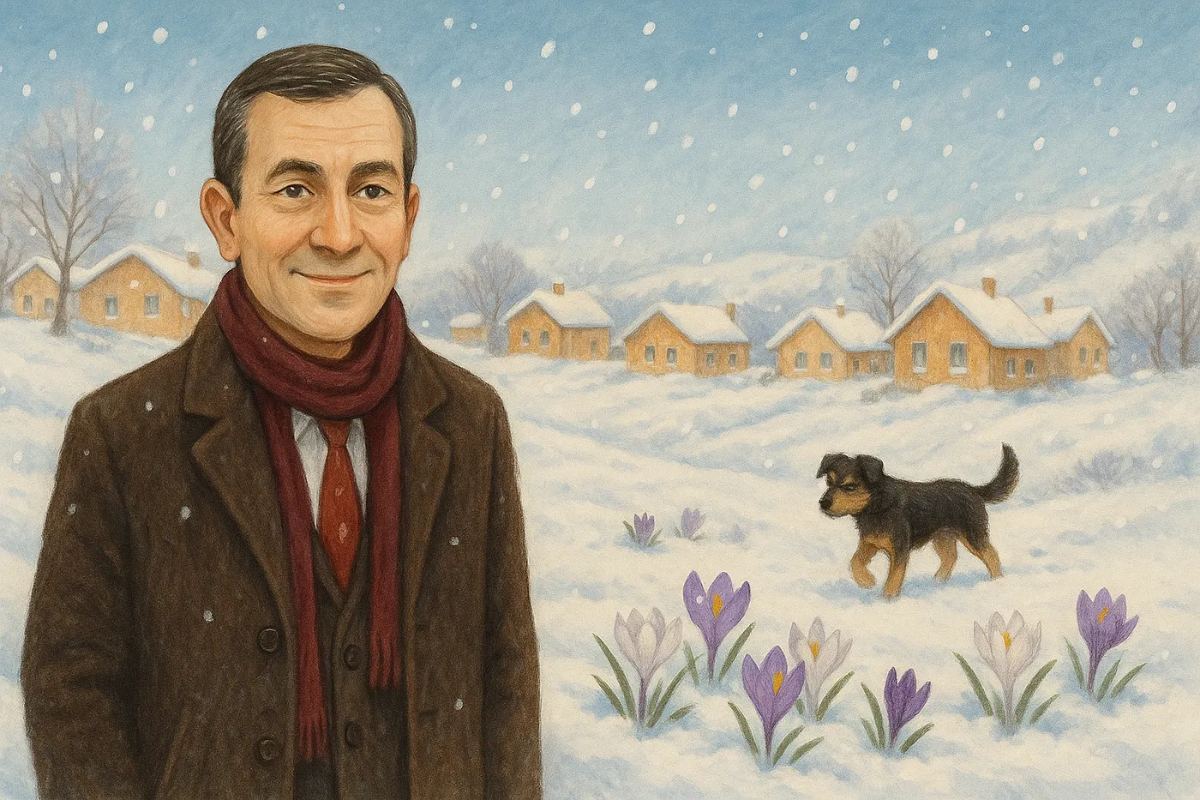
The image belongs to the author and was created by ChatGPT.
This article is the second part of the "The Principal Who Collects People" series. This time, we delve into my father's early years as a teacher; the snow-covered village roads, the classrooms without stoves, and the warm hearts he encountered. You can read the first article here:
In the previous article, the additions I made about management, an area of interest for me, were particularly pleasing to my father. However, what made him happiest were three things:
Sharing his memories,
The appreciation of these memories,
People reading and commenting on them.
I decided to turn the previous article into a series and write down my father's memories without adding any commentary.
" At the beginning of January 1981, a letter arrived from the Ministry of National Education: "Be in Sivas on February 2nd; your appointment has been made to the Sivas province." At that time, we had a furniture shop in Develi (a district of Kayseri); I was running the shop. I closed the shop, handed the keys to my father, and set off. I arrived early because there was excessive snowfall, frost, and freezing temperatures. The roads were also closed. I arrived in Sivas on the third day of January, found a hotel, and stayed there for two or three days.
On the fourth of the month, they called me for the lottery. “Choose a district that’s close to you and easy to get to,” they said. To make participation easier, the lottery was drawn district by district. By the time it was my turn, there were no schools left in Gemerek. So, because it was a bit closer than the other districts, I participated in the lottery from Şarkışla. I got Kazancık village in Şarkışla. That same evening, I went to Şarkışla and saw that the village roads were closed. Apparently, Kazancık wouldn’t open before March. Vehicles couldn’t get there. It’s a village high in the mountains. Transportation was impossible. No taxis, no minibuses…nothing.
I heard that the District Governor was providing his official jeep to these remote villages for transportation. On the fifth day of the month, I went to the District Governor: “Sir, the situation is like this. Even if it’s not in the budget, I’ll buy the gasoline for your jeep and take me to Kazancık,” I said.
“Sir, no jeeps can get there. We sent two female teachers to the other two villages, towards Altın Yayla, but the roads there were still more or less open. There were no working cars, so we gave them the jeep. The road to Kazancık is absolutely impossible to get open…”
“Mr. District Governor, how am I going to manage until March? We’ve worked our eyes out for so many years for ‘teaching.’” The District Governor laughed:
“Sir, there are twelve days left until the February holiday. Write a petition and bring it to me.”
Of course, I knew how to write a petition. I wrote to the District National Education Directorate. The Director would forward it to the District Governor. The District Governor would sign it, and then I would return to Develi.
The District National Education Director said that twelve days of leave couldn’t be granted. I told him that the District Governor had advised otherwise. “How? No! This is impossible,” he said. We went to the District Governor’s office. The Director came in, and they talked for a while.
“Okay,” they said, and signed my petition. They gave me twelve days' leave: "Go ahead, spend the February holiday in Develi. Then come back this way, and we'll figure something out." I went to Develi, and the February holiday ended.
Returning from Develi
I hired Hüseyin Abi's Murat 124 from Develi. I filled the tank and returned to Şarkışla.
They said, "It's impossible to go any further from here. There's an Osman Abi, he has a Renault; he works there. If anyone can take us, it's him, nobody else can." We found Osman Abi, and he agreed to take us. It was already late afternoon. Osman Abi loaded everything we could carry, including bedding, and I also bought five or six loaves of bread. So, we got in.
Darkness fell. The village was two kilometers away, with faint lights visible. Osman Abi said, "Sir, the village is over there. Look, this place is blocked by a blizzard. Neither the bulldozer nor the grader can get through, nor can my car pass. I'll wait here. You send word to the village." At that time, three of our teacher friends had frozen to death on the road while going to Zara and İmranlı. Their pain was within me, but my ambition to be a teacher overcame even my fear of death. “Okay,” I said. He started waiting by the belongings.
I started walking, and gradually the cold seeped into me; I couldn’t feel my hands and feet anymore. Almost freezing, I arrived at the village and went straight to the school. There was a very valuable teacher there named Mehmet Özdamarlar. This was his second time there. When I arrived, he became the acting principal. “Sir, you sit down,” he said. They lit the stove and took me to a room. They gathered the students and brought the belongings. Osman Abi had, of course, returned to Şarkışla from there.
For a while, we stayed as guests in a house in the village. The principal hadn’t had any trouble adapting because his wife was also from that village, but I couldn’t fit into any house.
“Principal, it’s like this… What am I supposed to do in people’s houses? Their customs are a little different, not like ours,” I said. He said, “Let’s arrange the principal’s office, you can sleep there until spring.” We arranged the principal’s office, and I moved there.
This time, I couldn't ask anyone for bread or food. I didn't know how to cook either. I found eggs in the village. Soft-boiled eggs in the morning, boiled eggs at noon, fried eggs in the evening… My bread had become like firewood. In that freezing weather, and the air in Sivas is very dry anyway… One day, while eating, I suddenly heard a "crunch" sound. One of my teeth broke. I had moistened the surface of the bread to soften it, but the inside was like stone, like iron. I lost a tooth there. I was very upset then: "Where did I come from? I should go and open that shop and run it," I thought, but there was no turning back. The roads were closed, it was impossible, they wouldn't open until March.
When I settled into the manager's office, I said, "I can't warm myself with the dung the students bring, that's their right." I said we needed firewood. They said there was firewood somewhere in the village. We went there to look for firewood, but the homeowner's son, Kazım, jumped in first, and I followed behind. Suddenly, a dog silently bit me from behind, in my buttocks. There was nowhere to get a rabies vaccine. No doctor, no nurse, nothing… They started counting: “The teacher has 40 days. If he survives 40 days, he will live; if he doesn’t, he will die of rabies.” No one would approach me anymore.
I had bought firewood at the price they quoted, and I was using it to warm myself. I wasn’t taking cow dung from the students. The students were supposed to bring the cow dung for the teachers to burn, but the children couldn’t carry their bags in that freezing cold. Seeing them broke my heart. I was lighting the classroom stove with my own firewood. I started staying in the principal’s office, but without food or bread… Thankfully, Mr. Mehmet brought food every day, but I was starting to feel ashamed of him too. He lived in the principal’s quarters next to the school.
Finally, one day I went to the village. They were gathered in a room. A woman was serving tea. I noticed that the women immediately got up from that room and went to another. They said:
“Well, teacher, is this your custom?”
“Don’t try to trick me with our customs! I came here through all this hardship. I’m just like you! What do you mean? Am I hungry or thirsty? Am I able to cook or not? What about my laundry? You know absolutely nothing!” The villagers were very pleased with my sincere attitude and my playful outburst. “Then you’re one of us now. Girls, bring the teacher some tea!” they said.
My tea arrived, and I started drinking it; it was so delicious I couldn’t get enough of it. It was winter, and everything was ice, snow, and blizzard…
A Principal Who Made a Difference, Experienced Everything in the Village
On my second day of teaching, I was bitten by a dog, and on my fourth day, I lost a tooth. That's how I started my job, but this profession is very different; the more I did it, the more I became addicted to it.
I have many more memories related to this village – especially my students. I will share them with you in the future. May God protect you.
My father ended the audio recording like this, but of course, I didn't leave him alone and immediately extracted another memory from this village. Well, we're lucky again. Let's listen: The last years of our student life were turbulent. We experienced many exiles, we went through four or five teacher training institutes. We withdrew from politics during the September 12th coup. What difficulties we went through; we were thirsty for people, for students. We became ambitious in teaching…
Finally, as we told in the previous story, our appointment was made. When I started my job in Kazancık, I spent ten days lecturing the children, filled with a thirst for knowledge. "Each of them could become a professor," I said. I'm a good orator too (don't we know that?). They listened without a sound.
There was also a very mischievous student named Hami. Everyone, including his father, said he was "mentally retarded" and that if I didn't hit him, he would prevent me from teaching.
Anyway, in the first lesson, I saw that Hami was very naughty. He wouldn't let me teach! The second day – you know how they taught me how to deal with Hami – I said, "Hami, come here!" and slapped him a couple of times. He immediately became sad. I was inwardly upset too, but we still had our lesson.
At the end of ten days, I thought, "Let me check on these students. What have they learned?" So, in class, I said, "Children, I've been giving you lectures for ten days. Write down a few sentences that you remember."
And I saw that no one had written anything. “Teacher, we don’t know how to read and write,” they said. Some were stuck on words, some on sentences, and some on syllables.
I called my colleague, Mr. Mehmet, who was the head teacher. We sat down and assessed the children’s level: there were one child in first grade, three in second, and six in third. Including the fours, I took on about twenty in total. Normally, they don’t combine the first and fifth graders; they combine the second, third, and fourth, but since there were two of us teachers, we were forced to combine them. Mr. Mehmet was looking at the fifth graders. The fifth graders alone were twenty-five. We started trying to get them to read and write.
Hami’s sadness on that first day still haunts me. One day I said to him:
“Hami, your friends… What’s your level?” In a deep, mature voice, he replied:
“Teacher… Two or three of them got married. And I’m just a simpleton. I get beaten at home; I come to school, I get beaten at school, and then I feel relieved.”
“This won’t do, let’s make a deal,” I replied.
Hami and I made a deal: I wouldn’t hit him, and he wouldn’t interrupt the lesson. Also, without anyone knowing, I would give him private lessons outside of class whenever I had the chance.
I quickly noticed his level from his interest and questions. Hami’s situation improved considerably, but no one knew. I pretended not to know either. For now, he wasn’t doing any reading in class. He would say, “Teacher, please excuse me, it’s not time yet.” He had learned to read, but his writing was weak. He was going to improve that and surprise everyone in class. I knew what he was doing, but I was playing the game according to Hami’s wishes.
At home, the beatings were over. I had already strictly warned the family, “No one will lay a finger on Hami.” This time, Hami had declared martial law: no one would give him orders, no one would enter his room… and so on.
Then, twenty or twenty-five days later, Hami's father, Şahin, came to the school, astonished, to express his gratitude: "Teacher! Did you cast a spell, or make an amulet? What are you?!"
"What's wrong?"
"No teacher, including us, could bring him (Hami) to heel by beating him. You don't beat him. You even sent word home that 'They shouldn't even slap him.' So we don't beat him. The boy has become strange; every night the light is on; when we go to turn it off at one or two in the morning, what do we see? He's fallen asleep in bed with a book, pen, and notebook in his hand. What did you read to him, what did you do to him?"
"That's our job as a teacher."
"He reads so well! But you don't make him read in class..."
"So?"
"He's also trying to organize his written expression; he's summarizing it, and then he'll read it!"
Not only the father, but the whole family was astonished. It was natural for them to be surprised to see their son, whom they called "mentally retarded," as a normal, intelligent person. After his father left, Hami came running: "Teacher, why did my father come?" "Hami, we're dropping a surprise in this lesson." It was Hami's turn to read. Hami started reading fluently. I even had fifth-grade books brought in, and he was reading those too! Hearing such flawless reading, the other students were amazed and told the whole village. The villagers were also surprised. Everyone started asking, "Teacher, how did this happen?"
Hami became my number one diligent student, but you'd think he was my subordinate, very close to me. He would follow me from afar so closely... "Teacher, do you need tea? Are you hungry...?" I never saw him, but when I said "Hami!" he would immediately appear...
In short, that's how it was with him...
We established a bond of friendship and love. It was a wonderful example for both the other students and the class. Both the other students and I were very motivated. A competition started so intense that we even forgot about recess. Five hours of lessons didn't seem long enough. Besides, there's no coffee shop in the village. It was great for me too. We spent such wonderful time with the children, I can't even describe it. Games, fun, and lessons mixed together. There was no longer a difference in reading and writing skills between first and fourth grade. Our class became a super class. By the way, the Inspector came, but let's talk about that another time.
There are no students who can't learn. There are only teachers who don't know how to teach.
Frequently Asked Questions
▸How did the teacher get assigned to Kazancık village in Sivas?
He received a Ministry of National Education letter in January 1981 directing him to Sivas. He participated in a district-by-district lottery and ended up assigned to Kazancık village in Şarkışla district after no schools were left in his preferred district of Gemerek.
▸Why couldn't the teacher reach the village by vehicle?
Kazancık is a high-mountain village, and heavy blizzards had completely closed the roads. Even the District Governor's official jeep couldn't get through, and no taxis or minibuses were operating on that route.
▸How did the teacher finally get to the village?
A driver named Osman Abi took him as far as his Renault could go, but the final stretch was blocked by a blizzard. The teacher walked the last two kilometers alone in freezing temperatures, arriving at the village nearly frozen.
▸Was the teacher afraid of the dangerous winter conditions?
Yes — he knew that three teacher colleagues had recently frozen to death on similar roads in the Zara and İmranlı areas. Despite this fear, he said his ambition to be a teacher overcame even his fear of death.
▸How did the teacher manage to get leave before the village roads opened?
He wrote a petition with help from the District Governor, which was signed after some back and forth with the District National Education Director. He was granted twelve days' leave to return home to Develi for the February holiday.
▸Where did the teacher sleep once he reached the village?
He initially stayed as a guest in a village home but felt uncomfortable with the different local customs. The resident teacher, Mehmet Özdamarlar, offered to convert the principal's office into a bedroom, where he stayed until spring.
▸What did the teacher eat while living alone in the village school?
Not knowing how to cook and unable to rely on others for food, he lived almost entirely on eggs — soft-boiled in the morning, boiled at noon, and fried in the evening — along with bread that had gone hard as firewood in the dry, freezing air.
▸Who helped the teacher when he first arrived at the village?
A teacher named Mehmet Özdamarlar, who was on his second posting at the village, welcomed him warmly. He lit the stove, gave him a room to warm up, and organized the students to retrieve the teacher's belongings from the road.