
Your Resume Might Be Getting Screened Out at a Glance! Here Are Some Behind-the-Scenes Tips.
- Preparing a Resume in 2026 Is Not Like It Used to Be! How Do You Prepare a CV?
- 1. How to Prepare an ATS-Friendly Resume?
- Use the Right Format and Font
- Use Keywords Correctly
- Simple Design and Layout
- Back Up Achievements with Numbers
- Include Your Links
- 2. How to Create a Resume That Appeals to the Eye?
- Create Eye-Catching Sections
- Write Clear, Measurable Achievements
- Use Bullet Points
- List Work Experience in Reverse-Chronological Order
- Be Results-Oriented (STAR Method)
- Keep It Simple
- 3. The Vital Importance of LinkedIn, GitHub, and Digital Visibility
- Your LinkedIn Profile Must Be Complete and Impressive
- GitHub: Let Your Code Do the Talking
- Kaggle and Other Platforms
- Don't Forget to Include Links in Your Resume
- 4. Common Resume Mistakes
- Pay Attention to Your Resume’s File Name
- Make Sure Dates Are Accurate
- Don’t Try to Hide Employment Gaps
- Avoid Unnecessary Embellishments
- Choose Your Photo Carefully
- Don't Write Excessively Long Paragraphs
- Don't Damage Your Reputation by Applying for Irrelevant Positions
- Pay Attention to Language Choice
- 5. Soft Skills: Just as Important as Technical Proficiency!
- Teamwork
- Communication Skills
- Problem-Solving Skills
- Adaptability and Flexibility
- Leadership Potential
- The Details That Make You, You
- 6. Bonus: The Final Touches That Land the Interview
- Tailor Your Resume for Each Application
- Play with Keywords
- Don't Underestimate the Cover Letter
- Have Your References Ready
- Provide Clear Contact Information
- Small Touches: QR Code & Portfolio Links
- Final Word
Contents
- Preparing a Resume in 2026 Is Not Like It Used to Be! How Do You Prepare a CV?
- 1. How to Prepare an ATS-Friendly Resume?
- Use the Right Format and Font
- Use Keywords Correctly
- Simple Design and Layout
- Back Up Achievements with Numbers
- Include Your Links
- 2. How to Create a Resume That Appeals to the Eye?
- Create Eye-Catching Sections
- Write Clear, Measurable Achievements
- Use Bullet Points
- List Work Experience in Reverse-Chronological Order
- Be Results-Oriented (STAR Method)
- Keep It Simple
- 3. The Vital Importance of LinkedIn, GitHub, and Digital Visibility
- Your LinkedIn Profile Must Be Complete and Impressive
- GitHub: Let Your Code Do the Talking
- Kaggle and Other Platforms
- Don't Forget to Include Links in Your Resume
- 4. Common Resume Mistakes
- Pay Attention to Your Resume’s File Name
- Make Sure Dates Are Accurate
- Don’t Try to Hide Employment Gaps
- Avoid Unnecessary Embellishments
- Choose Your Photo Carefully
- Don't Write Excessively Long Paragraphs
- Don't Damage Your Reputation by Applying for Irrelevant Positions
- Pay Attention to Language Choice
- 5. Soft Skills: Just as Important as Technical Proficiency!
- Teamwork
- Communication Skills
- Problem-Solving Skills
- Adaptability and Flexibility
- Leadership Potential
- The Details That Make You, You
- 6. Bonus: The Final Touches That Land the Interview
- Tailor Your Resume for Each Application
- Play with Keywords
- Don't Underestimate the Cover Letter
- Have Your References Ready
- Provide Clear Contact Information
- Small Touches: QR Code & Portfolio Links
- Final Word

Photo by cottonbro studio
Preparing a Resume in 2026 Is Not Like It Used to Be! How Do You Prepare a CV?
Do you know the most critical step when applying for a job? It’s your résumé.
If you’re racking your brain wondering, "Why am I not getting a response to my résumé?" you aren't alone. Submitting hundreds of applications for a single opening only to be met with silence has become a recurring nightmare for all of us (yes, myself included).
Here’s the harsh reality: often, your résumé gets screened out by automated systems before a recruiter even lays eyes on it! And that’s not to mention the impact of large language models...
Think of it this way: 98% of Fortune 500 companies use Applicant Tracking Systems (ATS)—screening tools often powered by AI and automation. This means the résumé you submit frequently passes through a digital filter without ever being touched by a human hand. Those "ruthless" ATS systems are particularly tough; if you don't write your résumé in a way that makes sense to both robots and humans, you get eliminated right off the bat! Let’s say you do clear the ATS filter—then you have to be ready for the HR specialist’s quick scan. They have only 7 seconds to review each résumé. Yes, 7 seconds! This is where the design, language, and highlighted details of your résumé become vital.
So, what are the current best practices for creating a résumé in 2025? How do you craft one that passes the ATS filter *and* grabs an HR specialist's attention?
Ask yourself these questions:
Is my résumé ATS-friendly?
Did I choose the right keywords?
Do I have sections that stand out?
Did I back up my achievements with data?
In this article, we’ll cover exactly that. We’ll walk you through, step-by-step, how to create a résumé that both clears the ATS filter and captures the interest of HR professionals.
Are you ready to reinvent your résumé? 🌟
Here we go!
1. How to Prepare an ATS-Friendly Resume?
To get along with the ATS (Applicant Tracking System), you need to organize your resume simply, clearly, and smartly rather than over-decorating it. ATS focuses on words, not visual designs. So, what should we do?
Use the Right Format and Font
Using fonts like Times New Roman, Arial, or Calibri at 11–12 point size is ideal.
Graphics, icons, and logos can confuse the ATS. Keep your resume text-heavy.
Save it as a PDF, as .docx files can sometimes cause opening issues.
Keep the filename simple and neat, like `surname_firstname.pdf`.
Use Keywords Correctly
Write the exact job title from the posting—e.g., "Software Engineer."
List your technical skills using standard terminology: React, Kotlin, SwiftUI.
Spell out acronyms: CI/CD (Continuous Integration/Continuous Delivery).
Simple Design and Layout
Use bullet points instead of paragraphs.
Keep each point clear and concise rather than using long blocks of text.
Back Up Achievements with Numbers
Instead of saying "I improved performance," use clearer statements like "I achieved a 35% increase in performance." This impresses HR specialists just as much as it does the ATS.
Include Your Links
Add links to profiles like LinkedIn and GitHub. This allows HR specialists to get a clearer view of your technical background and projects. Some ATS platforms can incorporate these links into the candidate profile; however, critical keywords must still appear within the resume itself.
Remember, to beat the ATS, we shouldn't write like robots, but like smart humans! And if we aren't smart humans, we should at least mimic them. 💪😉
2. How to Create a Resume That Appeals to the Eye?
Let’s say you’ve passed the ATS filter. Congratulations! But we aren't done yet. Here is the critical point: capturing the HR specialist's interest when they look at that resume. Because remember, you have an average of 7 seconds!
Your resume needs to shine in those 7 seconds!
Create Eye-Catching Sections
Highlight your most important skills and achievements.
Draw attention to your technical skills, especially by using bold text.
Get straight to the point instead of using unnecessarily long introductions.
Write Clear, Measurable Achievements
Don’t just write "I contributed to the project." Use concrete data, such as "I achieved a 35% performance increase in the XYZ project." Numerical data also grabs the attention of managers.
Use Bullet Points
Long paragraphs are intimidating. An HR specialist might skip right over them.
List your accomplishments under each work experience using bullet points:
1. Developed an enterprise content management system using React and Vue.js.
2. Accelerated the deployment process by 40% through CI/CD infrastructure integration.
3. Coordinated a 5-person team in a leadership role.
List Work Experience in Reverse-Chronological Order
It is more important for HR to see what you have specialized in recently. Your most current job should be at the top.
If a job you held 20 years ago is irrelevant to the current position, move it to the bottom. Making recent experiences stand out is critical, especially in multi-page resumes.
Be Results-Oriented (STAR Method)
Situation, Task, Action, Result
"Led the team's transition to a microservices architecture; we improved API response times by 50%."
Keep It Simple
Focus on readability rather than trying to be overly artistic with the design. A riot of colors, cluttered blocks, and overly creative resume formats often backfire.
Remember: Your resume is a showcase that represents you. You need to grab attention at first glance. What comes next depends on your interview performance—but we’ll get to that later.
3. The Vital Importance of LinkedIn, GitHub, and Digital Visibility
Okay, your resume has cleared the ATS filter and caught the HR specialist's eye. Yet, you find yourself not getting called for an interview. Why? Because the information on your resume doesn't align with your digital footprint!
A resume alone is no longer enough. Your LinkedIn profile, GitHub account, and even work on platforms like Kaggle serve as your digital storefront. Employers want to see you there, too.
Your LinkedIn Profile Must Be Complete and Impressive
What appears on your resume should also be reflected on your LinkedIn profile. Inconsistencies are immediately noticeable.
Get recommendations. Let former managers and colleagues vouch for you.
Share your projects and achievements. LinkedIn isn't just a resume; it’s a living portfolio.
GitHub: Let Your Code Do the Talking
If you’re a software developer, not having a GitHub account puts you at a disadvantage. It’s where you can showcase the quality of your code and your contributions to projects.
Be active. Popular repositories, regular commits, and open-source contributions demonstrate your practical skills.
Kaggle and Other Platforms
If you’re interested in data science or artificial intelligence, maintain a presence on platforms like Kaggle. Participate in competitions and publish your projects.
Don't Forget to Include Links in Your Resume
List your LinkedIn, GitHub, and Kaggle profiles in a prominent place on your resume. You could even include a QR code.
Let your digital footprint serve as evidence supporting your resume. After all, everyone is now scrutinized online, not just on paper.
Remember, that final touch bringing you one step closer to an interview might just be your digital profile!
4. Common Resume Mistakes
Okay, you’ve made it past the ATS filter, and your LinkedIn and GitHub profiles have caught the HR specialist's eye. However, you can still get eliminated due to very simple mistakes. Small details you overlook in your resume can completely ruin your chances. In this section, we’ll take a look at these errors.
Pay Attention to Your Resume’s File Name
Names like “CV_new_final_3” simply won’t do. Use the format `Surname_Name.pdf` and avoid Turkish characters. For instance, mine always uses the same name: `Alparslan_Selcuk_Develioglu_Resume.pdf`. It’s simple and professional.
Make Sure Dates Are Accurate
The start and end dates for your past jobs must be clear and consistent. If you list them incorrectly, discrepancies will quickly come to light during reference checks or when verifying social security registration dates.
Don’t Try to Hide Employment Gaps
Be open if you’ve had periods of unemployment. If you filled those gaps with projects, freelance work, or further education, list them. Besides, you wouldn't want to work for short-sighted employers who would reject you solely because of those gaps anyway.
Avoid Unnecessary Embellishments
Over-the-top graphics and unconventional designs can backfire with ATS systems and HR professionals. Simplicity often wins the day.
If your job involves design, feel free to showcase your artistry on platforms like Dribbble or Behance. Designers know this well; if you aren't a designer, don't worry about it.
Choose Your Photo Carefully
You aren't required to include a photo. If you prefer to be evaluated based on your work rather than your appearance, I have nothing but respect for that.
If you do decide to include a photo, please steer clear of wedding shots, vacation poses, pictures featuring children, friends, or family, as well as props like cigars or whiskey glasses, or heavy filters. These things make you lose credibility in the eyes of HR professionals. A professional, friendly photo is sufficient.
There is a saying I once heard regarding this:
Take a photo that reflects how you would look in the work environment, and use that.
Don't Write Excessively Long Paragraphs
No one wants to read a novel. Write concisely and clearly, using bullet points.
In some of my own roles, I’ve had to write at length because I worked hard and accomplished a lot—what can you do? 😎
Don't Damage Your Reputation by Applying for Irrelevant Positions
Don't apply for a Node.js position with an ASP.NET background. Read the job posting carefully; if you aren't a match, don't apply.
If you are looking to change careers, you can mention this in your cover letter. However, if they are seeking someone who can contribute immediately upon hiring, you might be eliminated.
Pay Attention to Language Choice
Generally, submit a Turkish CV for job postings in Turkey. Of course, if English is required, use English. But to be honest: I only have one CV, and it’s in English. I actually send that one everywhere. So, while I advise sending a Turkish CV, it doesn't make a huge difference.
Remember, sometimes small details make the biggest difference. Make it a habit to check these points when preparing your CV. 💡
5. Soft Skills: Just as Important as Technical Proficiency!
Sure, your technical skills might be top-notch—React, Node.js, Kubernetes, and so on. However, when choosing between two candidates, the final decision often comes down to soft skills—your personal competencies. This area is frequently overlooked, yet it can be the secret weapon that sets you apart.
Teamwork
Being a skilled developer isn't enough; you need to fit in well with the team. Can you solve problems collaboratively? Are you open to helping others?
Do you adhere to coding and naming conventions?
Do you participate in code reviews and provide feedback on pull requests?
Communication Skills
The ability to explain technical concepts simply and clearly is invaluable. Can you communicate effectively with your team, your manager, and clients?
Problem-Solving Skills
You encounter an unexpected error. Can you resolve the issue step-by-step without panicking?
Adaptability and Flexibility
Can you quickly adapt to changing projects and new technologies? Flexibility is highly prized, especially in the startup world.
Leadership Potential
Can you guide processes and take initiative within the team? Not everyone needs to be a leader, but the ability to take responsibility is crucial.
The Details That Make You, You
Alongside your technical skills and professional achievements, your social traits, personal qualities, and hobbies—the things that distinguish you from other candidates—are also incredibly valuable.
I mention that I’m a runner; this highlights my perseverance and disciplined nature. I also include links to my blog posts, which demonstrates my communication skills and my passion for sharing knowledge.
Don't hesitate to add these personal touches to your resume. Sometimes, it is precisely these details that make you stand out in an HR specialist's mind.
So, how do you showcase these skills on your resume?
Avoid overly generic statements. Instead of saying "I am a team player," provide concrete examples like, "I collaborated with a 5-person frontend team to launch Project X in two months."
Demonstrate your problem-solving abilities: for instance, "I resolved a critical API error within a single day, preventing a system outage."
Remember, alongside technical expertise, everyone wants a team member who works well with others and approaches problems with a solution-oriented mindset. 🌟
6. Bonus: The Final Touches That Land the Interview
Okay, you’ve cleared the ATS filter; your technical and soft skills shine, and your LinkedIn and GitHub profiles look fantastic. But sometimes, securing that final interview invitation requires going the extra mile. Here are those finishing touches:
Tailor Your Resume for Each Application
Every job posting is different. A single, static resume won't fit every role. Review the job listing and weave the critical skills mentioned there into your resume. Even I—and I’m not exactly the most industrious person—have done this a few times. For instance, I have a separate resume specifically for software architect positions.
Play with Keywords
ATS systems sometimes fail to recognize synonyms or words with similar meanings. Instead of using overly generic terms, make sure to use the exact terminology found in the job description. For example, you might need to write "Frontend Developer (React)" instead of just "React Developer."
Don't Underestimate the Cover Letter
I know, most people avoid writing cover letters. But sometimes, that’s exactly what sets you apart. Write a cover letter that is concise and clear, yet personal. Why do you want the position? Why that company? Why you?
Have Your References Ready
Having your references lined up in advance can make a real difference. It’s especially great if you can get recommendations on LinkedIn.
Also, let the people you plan to list as references know beforehand. After a brief chat, be sure to ask, "If they call you about this, would you be willing to serve as a reference for me?"
Provide Clear Contact Information
It’s the simplest yet most critical detail. Is your phone number correct? Is your email address professional? Something like alp.develioglu@gmail.com.
Small Touches: QR Code & Portfolio Links
You can add a QR code so the employer can easily access your LinkedIn profile or portfolio site.
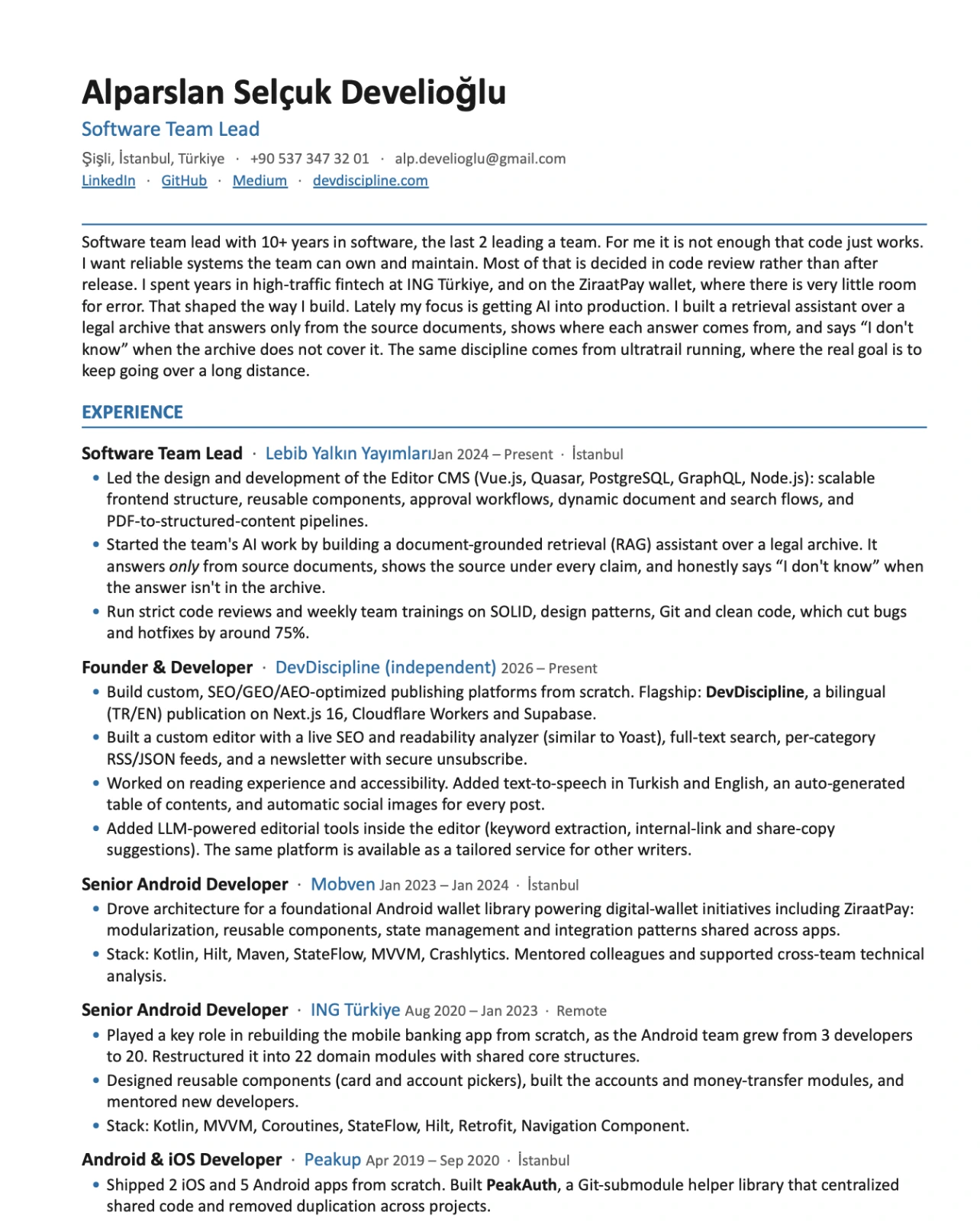
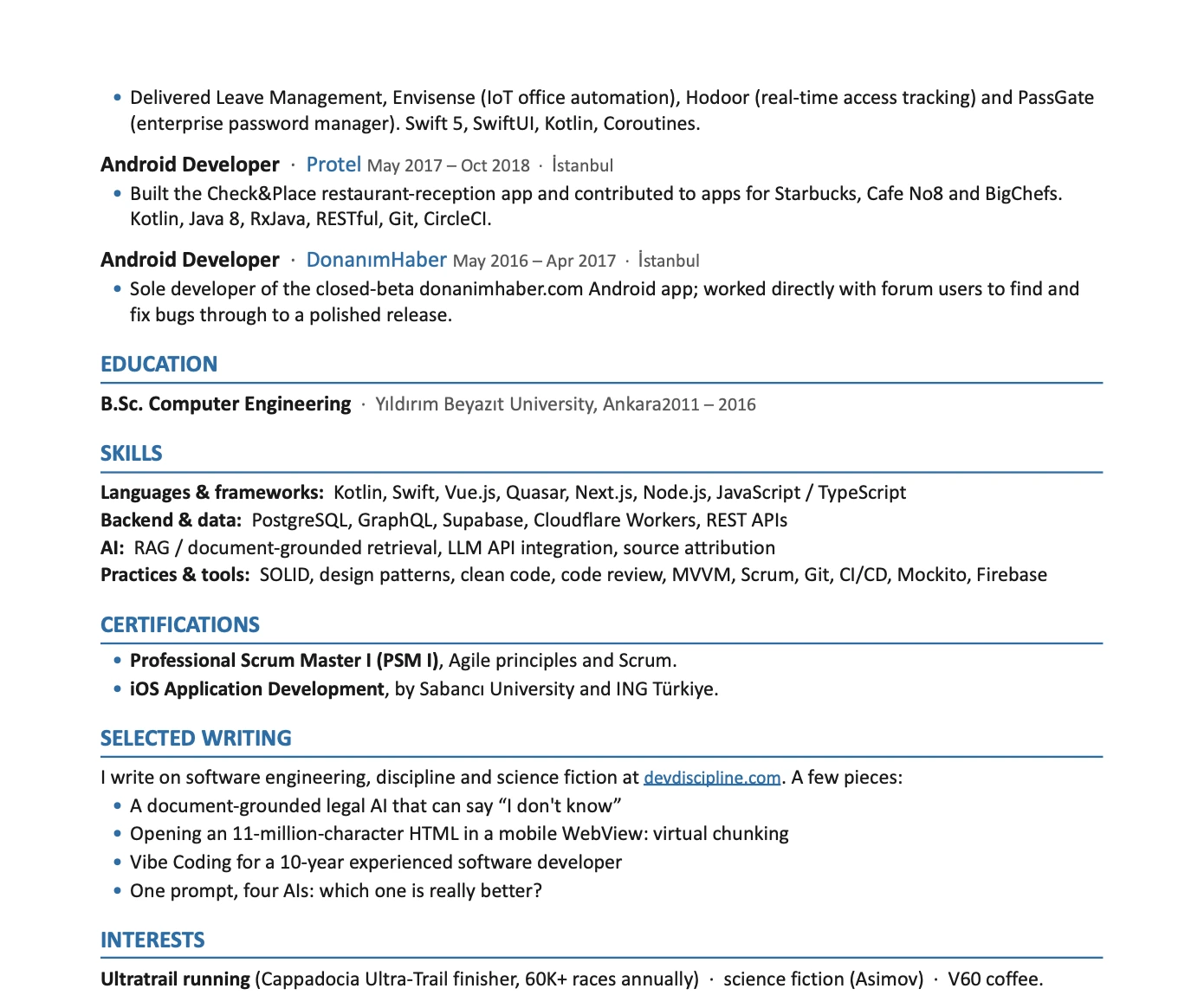
Well! After all that talk, I naturally can't skip including my own resume.
I made an effort to apply the rules I mentioned.
I used simple, standard fonts.
I used a simple photo.
I bolded the technologies I use.
I included my links.
I prominently displayed my iOS app development and PSM I certifications.
I listed my blog posts at the bottom, describing them in a way that impresses technical people while remaining understandable to everyone.
I mentioned my hobbies simply by name: running, science fiction books, and blogging. I actually have a few other hobbies I could list, but I don't know why I didn't. For instance, I could add playing the *bağlama*. These are the things that really define a person—they’re almost the first things that *should* be asked about, in my opinion—yet I’ve seen very few people who care about them. Still, I include them. I’m trying to teach by writing.
I really ought to be more concise about my work experience, but whenever I shorten it further, it feels like the substance gets lost. I tried hard, but unfortunately, I couldn't cut it down.
I placed my contact number and email address right after the headings. Some people prefer calling; I have nothing but respect for that.
You know how people assign star ratings to skills? That really bugs me. By whose standards are you assigning those stars, anyway? I just listed the skills by name.
My work experience is listed in reverse chronological order.
Here is how I handled the idea of backing things up with quantitative data: We were releasing an average of 4 urgent production patches (hotfixes) per sprint. Once we established a code review discipline, PR checks, and staging tests, that number dropped to one. That meant hotfixes decreased by 75%. I’m not kidding. People always recommend backing things up with numerical data, but actually measuring that is really hard. 😂
I used to have a resume with emojis in the "About" section. I deleted most of them. I used quite a few in this post, but hey—it’s my post, so I do what I want.
You can't see the filename here, but I mentioned earlier that I named it `Alparslan_Selcuk_Develioglu_Resume.pdf`. If you don't believe me, drop your email address in the comments and I'll send it to you. 🤪
I didn't add a QR code, though it could be a nice touch. Then again, I don't want to cut down on the text in my posts or my resume—so there's simply no room.
I’ve grown to like the goatee look, and my wife likes it too. I might update the photo; the current one is pretty old.
Bento got shut down, you know. How did that happen? I had all my links set up so nicely there. At least now that I’ve launched my blog, I don't have to go looking for a site just to host my links.
Screenshot by author
Screenshot by author
Final Word
Your résumé gets you to the interview, but landing the job depends on your performance during it.
What I’ve written here is a guide, but remember: every career journey is different. Adapt it to your own situation, experiment, and refine it! 🌟

Frequently Asked Questions
▸What is an ATS and why does it matter for my resume?
An Applicant Tracking System (ATS) is an automated screening tool used by 98% of Fortune 500 companies to filter resumes before a recruiter ever sees them. If your resume isn't formatted and worded correctly, it gets eliminated before any human reviews it.
▸What fonts and file formats work best for ATS-friendly resumes?
Use standard fonts like Times New Roman, Arial, or Calibri at 11–12 point size. Save your resume as a PDF and name the file simply, like surname_firstname.pdf. Avoid graphics, icons, and logos, as they can confuse ATS systems.
▸How do I use keywords correctly on my resume?
Use the exact job title from the posting, such as 'Software Engineer,' and list technical skills with standard terminology like React, Kotlin, or SwiftUI. Always spell out acronyms — for example, write 'CI/CD (Continuous Integration/Continuous Delivery)' rather than just the abbreviation.
▸How long does an HR specialist spend looking at a resume?
HR specialists spend an average of just 7 seconds scanning each resume. This makes it critical to use bold text for key skills, lead with your strongest achievements, and avoid long paragraphs that slow down readability.
▸Should I use bullet points or paragraphs on my resume?
Always use bullet points instead of long paragraphs. Long blocks of text are intimidating and HR specialists may skip right over them. Each bullet should be clear, concise, and ideally tied to a measurable result.
▸How do I show achievements effectively on a resume?
Back up every achievement with specific numbers instead of vague claims. For example, write 'I achieved a 35% performance increase in the XYZ project' rather than 'I contributed to the project.' Numerical data impresses both ATS systems and human reviewers.
▸What order should I list my work experience?
List work experience in reverse-chronological order, placing your most recent job at the top. If a role from 20 years ago is irrelevant to the position you're applying for, move it toward the bottom so recent, relevant experience stands out.
▸What is the STAR method and how does it apply to resumes?
STAR stands for Situation, Task, Action, Result. Applying it to your resume means framing accomplishments with context and outcome — for example, 'Led the team's transition to a microservices architecture; improved API response times by 50%.'
▸Why isn't a resume alone enough to get an interview in 2026?
Recruiters now cross-check your resume against your digital presence. If your LinkedIn profile, GitHub account, or platforms like Kaggle don't align with what your resume claims, it raises red flags and can cost you the interview call.
▸Should I include links to LinkedIn or GitHub on my resume?
Yes. Adding links to LinkedIn and GitHub lets HR specialists verify your technical background and see real projects. Some ATS platforms can pull in these profiles, but critical keywords must still appear within the resume text itself.
▸Are creative or visually complex resume designs a good idea?
No. A riot of colors, cluttered blocks, and overly creative formats often backfire. Focus on readability and simplicity — a clean design helps both ATS systems parse your content and HR specialists scan it quickly.